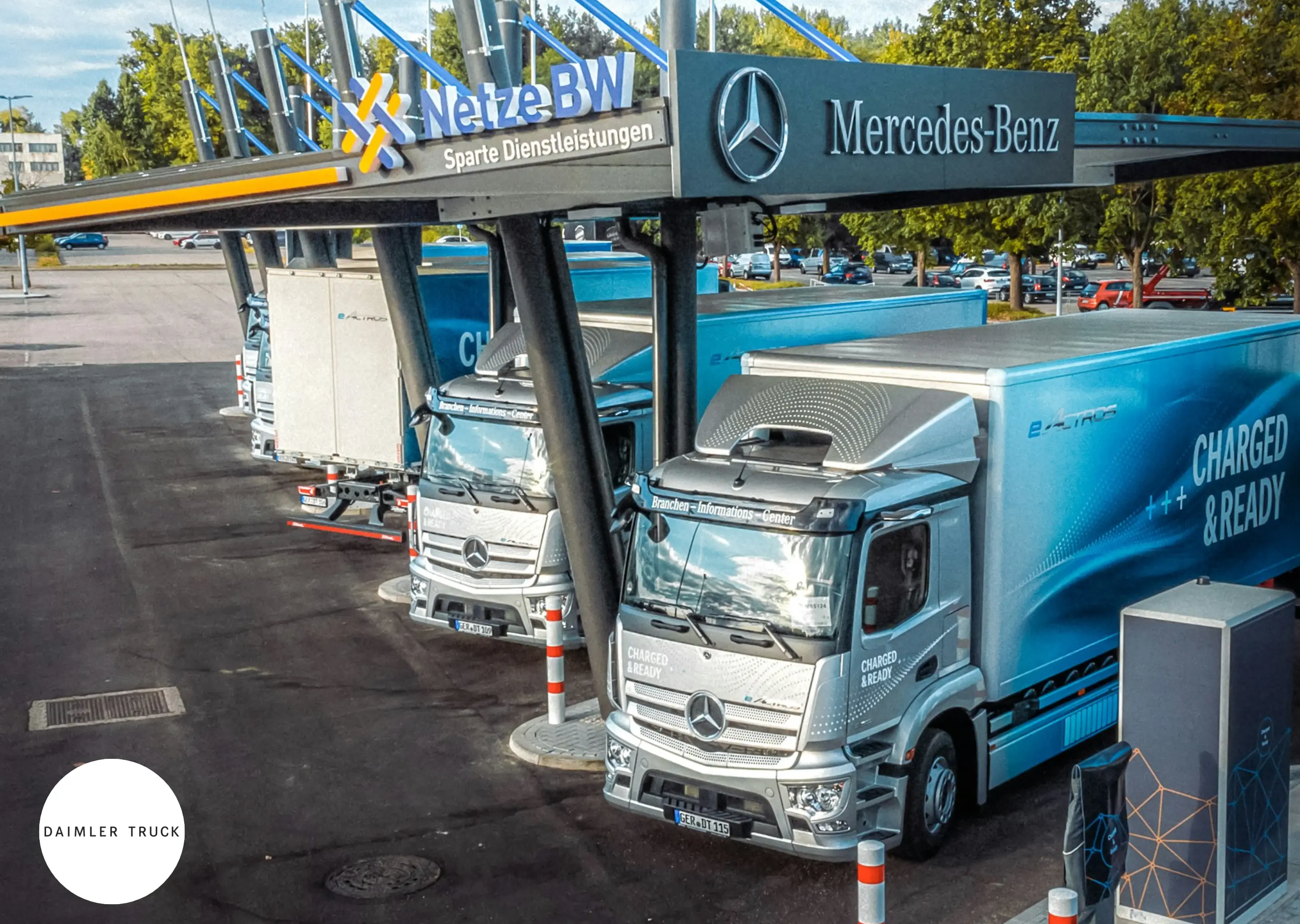
Daimler Truck makes money mainly by selling commercial vehicles, spare parts and related services, supported by captive financing and leasing. Its product base covers medium and heavy-duty trucks, buses, coaches and bus chassis under brands including Freightliner, Western Star, Mercedes-Benz Trucks, BharatBenz, Thomas Built Buses, Setra and Mercedes-Benz Buses.
The business is organized around continuing industrial operations and Financial Services. As of the Q1 2026 reporting structure, the main industrial segments are Trucks North America, Mercedes-Benz Trucks and Daimler Buses. Mitsubishi Fuso was transferred into ARCHION Corporation on April 1, 2026, so the former Trucks Asia segment is no longer a separately reported continuing segment and the ARCHION stake is accounted for using the equity method.
- Trucks North America: Freightliner and Western Star give Daimler Truck a leading position in the North American medium and heavy-duty truck market. This is usually the group’s largest profit pool, but Q1 2026 showed its cyclicality. Unit sales fell 25% to 29,432 vehicles, revenue fell 29% to €3.838 billion and adjusted EBIT dropped to €209 million as weaker demand and tariffs hit profitability.
- Mercedes-Benz Trucks: This segment covers Europe, Latin America and selected international markets, and now includes India and China activities after the 2025 integration of those businesses into the segment. In Q1 2026 it became the largest segment by unit sales, with 34,486 vehicles sold, up 13%, revenue of €4.605 billion and adjusted EBIT of €233 million.
- Daimler Buses: This segment sells city buses, intercity buses, coaches and chassis. It remained the most profitable industrial segment by return on sales in Q1 2026, with an 8.6% adjusted return on sales despite unit sales falling 20% to 4,972 vehicles.
- Financial Services: This business finances and leases Daimler Truck vehicles for customers and dealers. It supports vehicle sales and customer retention, while adding exposure to credit losses, interest rates, funding costs and residual values. Q1 2026 revenue was €839 million and adjusted EBIT was €39 million.
Daimler Truck’s revenue and earnings are strongly tied to truck replacement cycles, freight demand, pricing, supply-chain costs, tariffs and customer fleet investment. In Q1 2026, group unit sales fell 9% to 68,849 vehicles and revenue fell 13% to €9.981 billion. Adjusted group EBIT declined 54% to €498 million, while the Industrial Business adjusted return on sales fell to 5.0% from 9.6% a year earlier. The sharp profit decline shows the operating leverage in heavy commercial vehicles.
The company’s competitive advantages are scale, brand breadth, dealer and service networks, and strong positions in the most important Western truck markets. Management describes Daimler Truck as one of the world’s largest commercial-vehicle manufacturers, with about 100,000 employees and 35 main locations globally. It has stated that the company is the market leader in medium and heavy-duty trucks in North America and Europe.
Direct competitors include Volvo Group, Traton, Paccar, Iveco Group, MAN, Scania, Navistar, Isuzu, Hino and Chinese heavy-truck manufacturers in selected markets. Paccar is the closest listed US peer for North American trucks through Kenworth and Peterbilt. Volvo Group is the broadest global peer, with trucks, buses, construction equipment and financial services. Compared with Paccar, Daimler Truck has broader geographic and product exposure through European trucks and buses, but that also brings more restructuring complexity and emerging-market exposure.
Daimler Truck’s market position remains strong, but Q1 2026 highlighted regional pressure. North America was the main weakness, while Mercedes-Benz Trucks benefited from higher EU30 volumes and Daimler Buses delivered resilient margins. Incoming orders rose 50% year over year to 114,043 units, including an 86% increase at Trucks North America and a 33% increase at Mercedes-Benz Trucks, which supports management’s expectation of volume recovery later in 2026.
Zero-emission vehicles are still a small part of the business. Daimler Truck sold 742 zero-emission trucks and buses in Q1 2026, up 26% year over year, equal to about 1.1% of total unit sales. For full-year 2025, battery-electric vehicle sales were 6,726 units, up from 4,035 in 2024. Electrification is strategically important, but current earnings remain driven by diesel truck and bus platforms, parts, service and financing.
China is strategically relevant through the Beijing Foton Daimler Automotive joint venture with Foton Motor, which produces and sells Auman and Mercedes-Benz trucks in China. It is not presented as a major standalone revenue or profit driver in current continuing operations. Asia IFRS 15 revenue was €516 million in Q1 2026, about 5.7% of group IFRS 15 revenue, and the company does not disclose China revenue separately in the quarterly release.