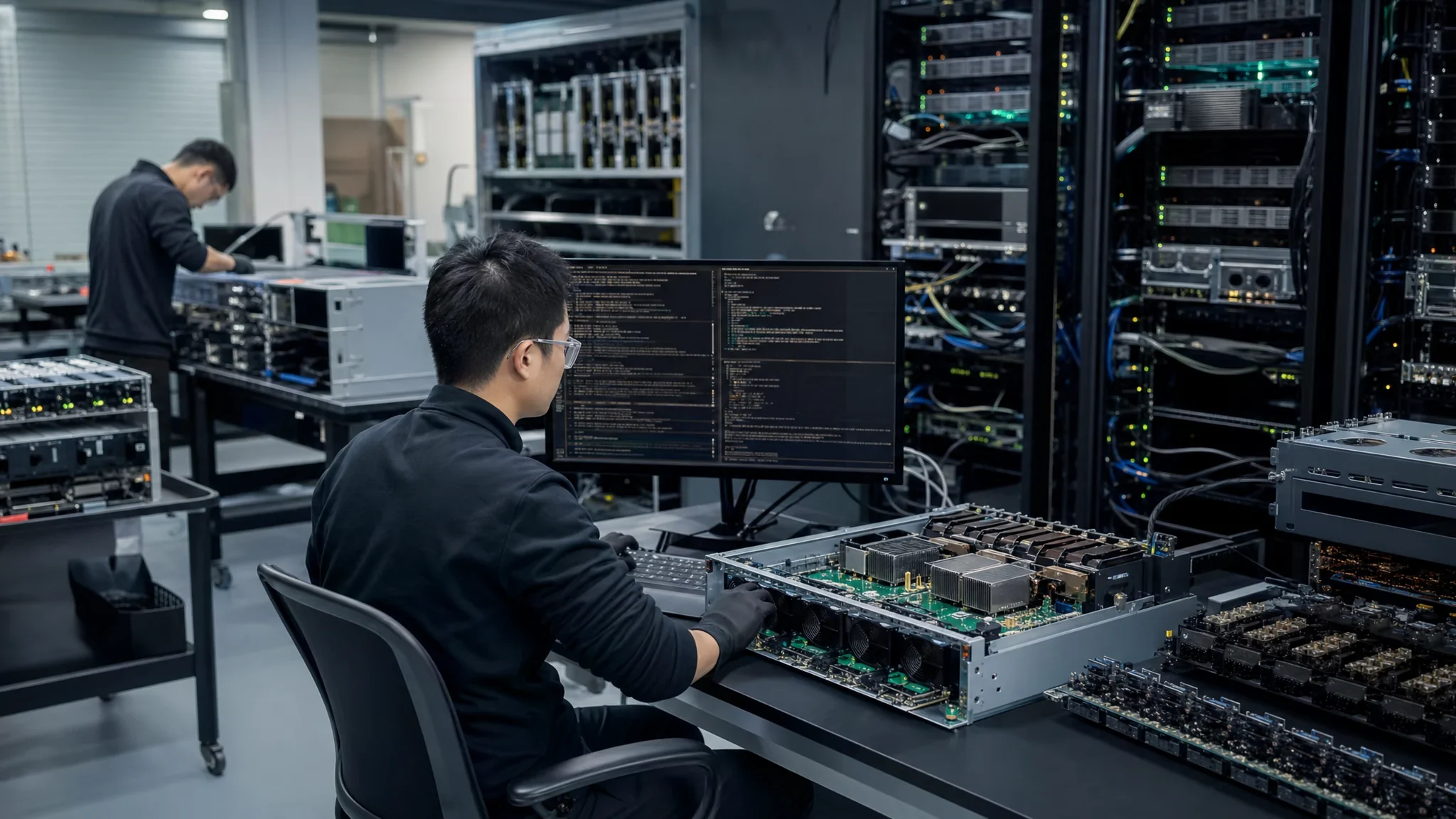
Nvidia makes money by selling accelerated-computing platforms for AI, high-performance computing, graphics, robotics, automotive, and edge applications. Its model combines chips, boards, full systems, networking products, software libraries, enterprise AI software, reference architectures, and ecosystem partnerships. The company’s strategy is to capture a larger share of the AI infrastructure stack rather than sell standalone GPUs alone.
In Q1 fiscal 2027, the quarter ended April 26, 2026, Nvidia reported revenue of $81.6 billion, up 85% year over year. GAAP gross margin was 74.9%, and Data Center revenue reached $75.2 billion, equal to about 92% of total revenue. This confirms that Nvidia’s business is now dominated by AI data-center infrastructure rather than gaming graphics.
Nvidia now reports through two main operating platforms
- Data Center: This is the core profit engine. It includes hyperscale customers, AI clouds, industrial users, enterprises, and sovereign AI projects. Revenue was $75.2 billion in Q1 fiscal 2027, up 92% year over year, driven by the Blackwell 300 ramp and demand for InfiniBand, Spectrum-X Ethernet, and NVLink.
- Edge Computing: This includes PCs, game consoles, workstations, AI-RAN base stations, robotics, and automotive platforms. Revenue was $6.4 billion in Q1 fiscal 2027, up 29% year over year. Growth came from Blackwell workstation demand, partly offset by softer consumer PC demand linked to higher memory and system prices.
Within Data Center, Nvidia’s customer base is split between large hyperscale cloud and internet companies and the AI Clouds, Industrial & Enterprise category. In Q1 fiscal 2027, hyperscale revenue was $37.9 billion, while AI Clouds, Industrial & Enterprise revenue was $37.4 billion. This balance matters because it shows Nvidia’s growth is broadening beyond the largest cloud platforms into enterprise, industrial, sovereign, and specialized AI infrastructure buyers.
Nvidia’s main revenue streams include
- AI accelerators and systems: GPUs, CPUs, boards, servers, and rack-scale systems used for AI training and inference.
- Networking: InfiniBand, Spectrum-X Ethernet, NVLink, and related products that connect AI clusters and increase Nvidia’s share of AI-factory spending.
- Software and platform layers: CUDA-X libraries, AI software, enterprise tools, and reference designs that support customer adoption and raise switching costs.
- Edge and physical AI platforms: Workstations, gaming and PC products, automotive systems, robotics platforms, and AI-RAN infrastructure.
Nvidia’s strongest competitive advantages are scale, software depth, product cadence, and platform breadth. CUDA remains a major developer ecosystem advantage, while Nvidia’s hardware stack extends from GPUs and CPUs to DPUs, networking, systems, and rack-scale AI-factory designs. The company also benefits from rapid platform transitions, with Blackwell driving current growth and Vera Rubin positioned as the next major architecture for agentic AI and next-generation AI factories.
The company relies heavily on third-party foundries, advanced packaging, assembly, test, memory, and supply-chain partners. This gives Nvidia an asset-light manufacturing model relative to owning fabs, but it also makes supply access, HBM availability, packaging capacity, and partner execution central to its revenue growth.
Nvidia is the leading merchant supplier of accelerated-computing infrastructure for AI training and inference. Its position is broader than that of a traditional semiconductor vendor because it sells an integrated AI infrastructure platform covering compute, networking, software, and system design. Q1 fiscal 2027 free cash flow of $48.6 billion and quarter-end cash, cash equivalents, and marketable debt securities of $50.3 billion also give the company significant financial flexibility.
Direct competitors include AMD and Intel in accelerators and CPUs, hyperscaler internal chips such as Google TPUs and Amazon Trainium, and specialized AI ASIC vendors. AMD is the clearest public market comparison because it competes directly in GPUs, data-center accelerators, CPUs, and AI infrastructure. Nvidia’s advantage versus AMD is its larger installed base, more mature CUDA software ecosystem, broader networking assets, and deeper position in full AI-factory systems. AMD remains relevant because large cloud customers want alternative suppliers and lower-cost options.
China is an important strategic variable but is not driving current reported growth. Nvidia reported no Data Center Hopper shipments to China in Q1 fiscal 2027, compared with $4.6 billion in Q1 fiscal 2026. Its Q2 fiscal 2027 outlook for $91.0 billion of revenue also assumed no Data Center compute revenue from China. This reduces near-term dependence on China data-center compute sales, while export controls and policy uncertainty remain material risks.
Nvidia’s market position is exceptional, but the competitive risk is rising. Major cloud customers continue buying Nvidia systems at large scale, yet they are also investing in internal silicon to reduce AI infrastructure costs. The key investor question is whether Nvidia’s software ecosystem, networking attach, and full-stack system value keep its platform premium intact as AI infrastructure spending grows and customers seek more bargaining power.