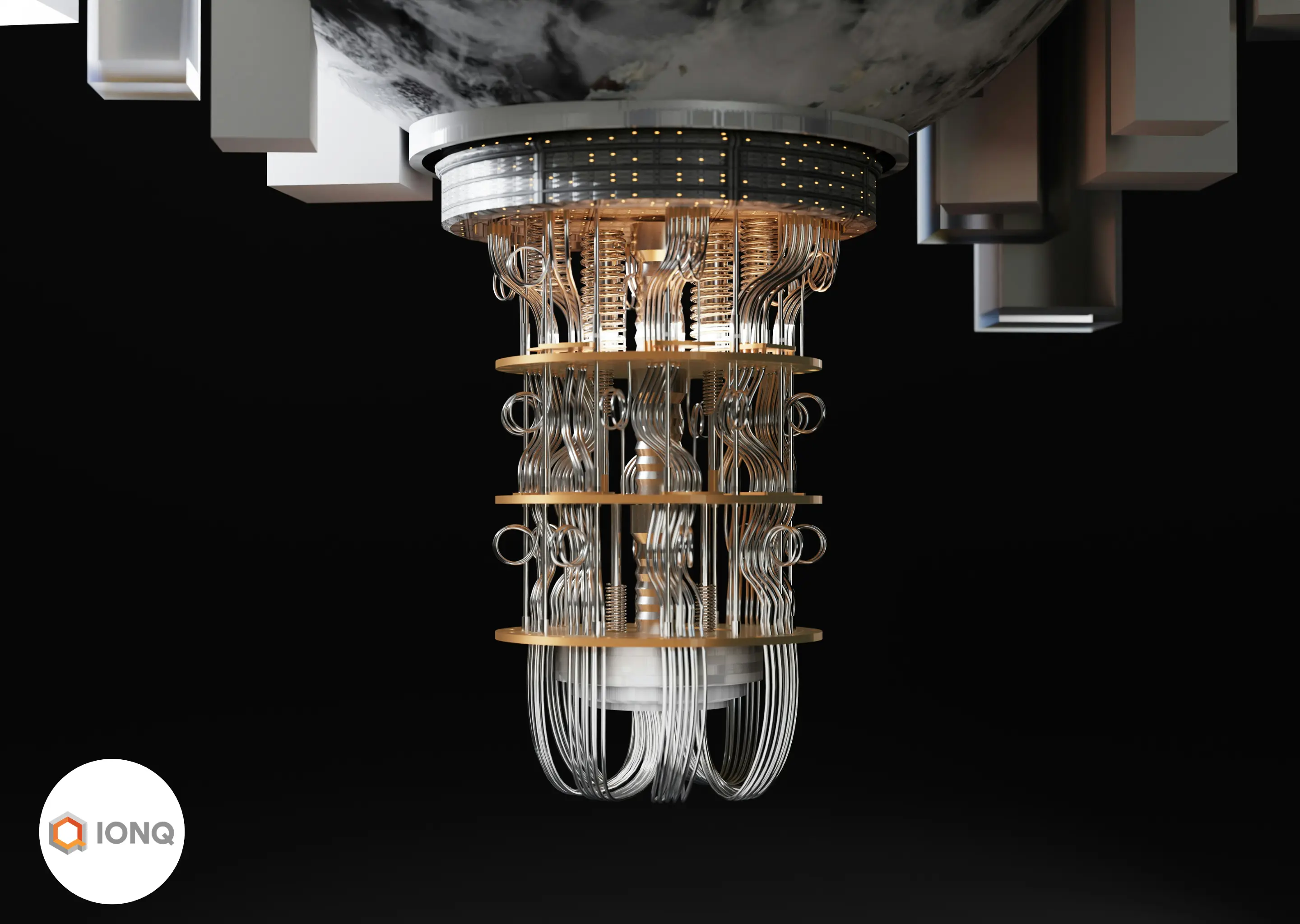
IonQ makes money by selling access to and deployments of trapped-ion quantum technology. Its model includes cloud-based quantum computing access, direct enterprise and on-premise quantum systems, government contracts, and a widening set of quantum networking, security, sensing, and communications products. The company is still in the investment phase, with revenue growing quickly but core operations deeply loss-making.
In Q1 2026, IonQ reported revenue of $64.7 million, up 755% year over year. Management raised 2026 revenue guidance to $260 million to $270 million. The scale-up is meaningful, but the economics remain immature. Q1 2026 cost of revenue excluding depreciation and amortization was $49.3 million, while R&D expense was $125.7 million and G&A expense was $88.6 million. The company’s GAAP net income of $805.4 million was driven by a $1.06 billion warrant-liability fair-value gain rather than operating profitability. Loss from operations was $271.5 million.
- Cloud access: IonQ sells access to its quantum computers through Amazon Braket, Microsoft Azure, Google Cloud, and IonQ Quantum Cloud. This gives enterprises, researchers, and developers a way to use IonQ systems without buying hardware.
- Direct system sales: IonQ sells full quantum systems to institutions and enterprise customers. A key Q1 2026 proof point was the sale of its first 6th-generation, chip-based, 256-qubit system to the University of Cambridge, paired with a secure quantum network and broader IP-generation partnership.
- Government and defense contracts: IonQ serves U.S. government and defense customers in areas such as modular quantum computing, secure communications, tactical space communications, and missile defense-related technology. Q1 2026 wins included selection for DARPA’s HARQ program, a $39 million Space Development Agency HALO contract, and selection to support the Missile Defense Agency’s SHIELD IDIQ contract.
- Quantum networking and security: The company is expanding beyond computing into quantum communication networks, quantum memory nodes, secure communications, and quantum key distribution. Recent activity included a National Quantum Communication Network deployment in Poland and a quantum memory node sale into the U.S. Mid-Atlantic Regional Quantum Internet.
- Merchant supply and manufacturing strategy: IonQ is building a broader full-stack platform. Its pending acquisition of SkyWater Technology is intended to add U.S.-based semiconductor manufacturing capabilities, while acquisitions such as Skyloom, Oxford Ionics, Lightsynq, and Capella expand its capabilities in lightwave optics, electronic qubit control, interconnects, quantum internet, and space-based secure communications.
IonQ’s main competitive advantage is its trapped-ion architecture, combined with an effort to control more of the quantum stack from hardware and software to networking and manufacturing. The company also benefits from a strong balance sheet for an early-stage quantum company, with $3.1 billion in cash, cash equivalents, and investments at March 31, 2026. That financial position supports R&D, acquisitions, customer deployments, and government-program execution despite Q1 2026 operating cash use of $151.0 million.
Its market position is that of a leading commercial trapped-ion quantum company rather than a mature technology vendor. IonQ has moved past pure research-stage positioning through cloud availability, system sales, government awards, and international networking deployments. At the same time, revenue remains small relative to spending, and contract timing creates lumpiness.
Direct competitors include quantum hardware companies using different technical approaches, including superconducting qubits, neutral atoms, photonics, annealing, and other architectures. Relevant peers include IBM and Google in superconducting quantum computing, D-Wave in quantum annealing, and other private or public quantum developers pursuing neutral-atom, photonic, and trapped-ion systems. Compared with IBM or Google, IonQ is more focused and more financially exposed to quantum adoption. Compared with diversified global technology peers, IonQ offers higher direct quantum upside but carries far greater operating, technical, and funding-execution risk.
China is not a meaningful disclosed demand market for IonQ. The company’s visible international activity is more concentrated in Europe, the United Kingdom, Switzerland, Poland, and South Korea. Given IonQ’s exposure to quantum computing, networking, security, space, and defense, China is more relevant as an export-control and geopolitical sensitivity than as a current revenue driver.