Last Updated -

April 19, 2026

Meituan

Company Profile and Market Insights

Explore the business model, global strategy, and market performance including insights into its position in China.

Meituan
Key facts
Founded March 2010 • HKEX: 3690 / 83690 • FY 2025 results (year ended Dec 31, 2025)
RMB364.9b
Revenue (FY 2025)
RMB(23.4)b
Loss for the year (FY 2025)
RMB(13.8)b
Adjusted EBITDA (FY 2025)
RMB260.8b
Core Local Commerce revenue (FY 2025)
RMB104.0b
New Initiatives revenue (FY 2025)
71.5%
Core Local Commerce share (FY 2025 revenue)

About

Founded in 2010 by Wang Xing and headquartered in Beijing, Meituan is a Chinese platform for local services and retail. The company says it follows a “Retail + Technology” strategy and focuses on the digital upgrading of services and goods retail on both the supply and demand sides. Meituan listed on the Hong Kong Stock Exchange on September 20, 2018, and its stated mission is “We help people eat better, live better.”

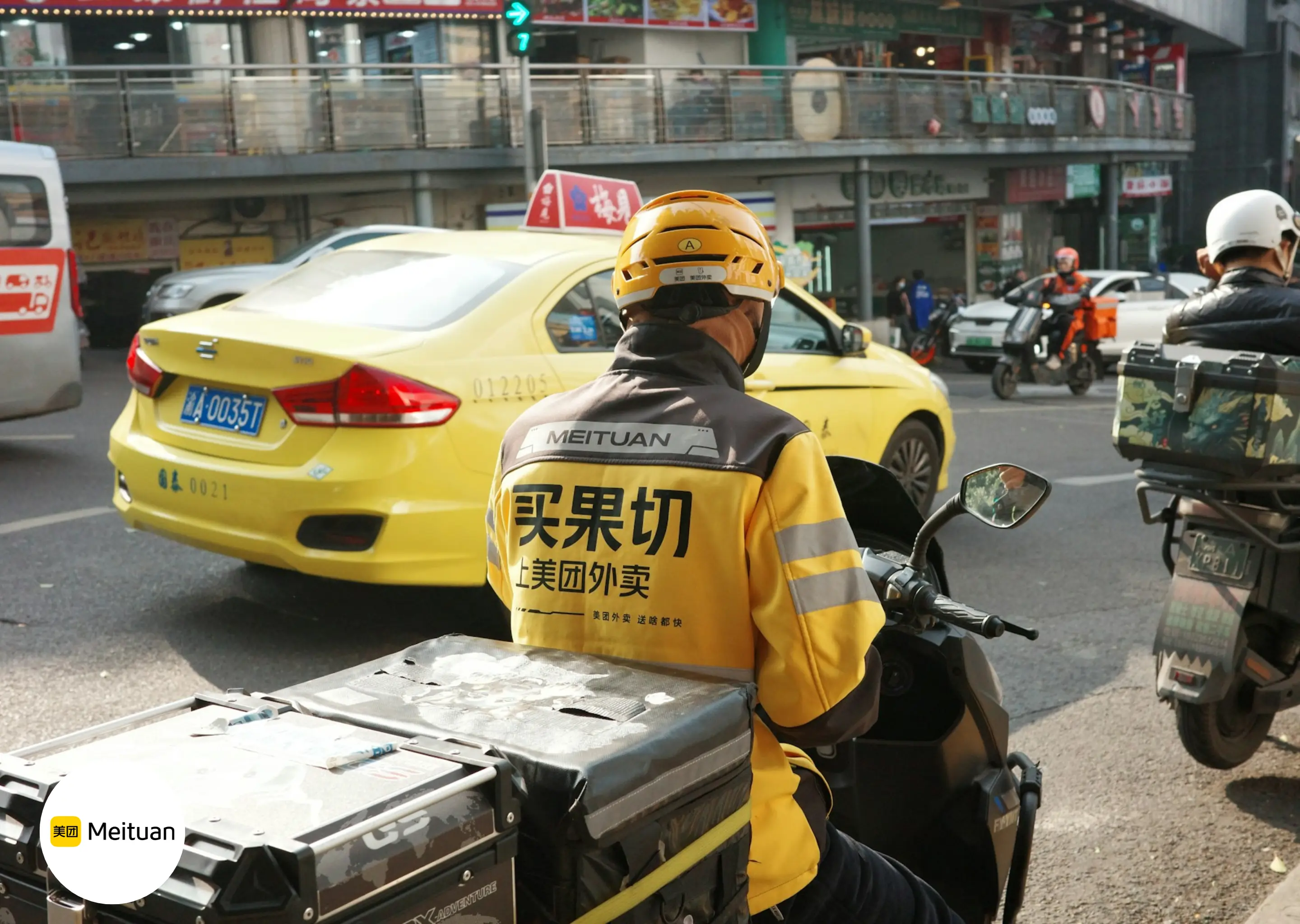
The business now spans food delivery, in-store services, hotel and travel booking, grocery retail, and a broader set of local commerce services. In its 2024 annual report, Meituan said both annual transacting users and annual active merchants reached new highs. By late 2025, Meituan’s own data platform said annual transacting users had passed 800 million, with coverage across more than 370 cities in China.

The latest company snapshot shows a business that is still scaling and still investing for its next phase. Meituan reported RMB 364.9 billion in 2025 revenue and said it is pushing deeper into AI, including its LongCat models and AI assistants inside the Meituan app, while also expanding unmanned aerial delivery, autonomous delivery vehicles, and overseas operations through Keeta. That keeps Meituan deeply embedded in everyday consumption across China, from meals and groceries to travel and local services.

Meituan

Business Model and Market Position

Meituan runs a local services platform with two reporting segments, Core Local Commerce and New Initiatives. Management frames the company around a “Retail + Technology” strategy and a one-stop local services platform. In 2025, revenue rose 8.1% to RMB 364.9 billion. Core Local Commerce generated RMB 260.8 billion, while New Initiatives generated RMB 104.0 billion. Revenue came from delivery services, commission, online marketing services, and other services and sales.

  1. Food delivery and quick commerce
    This is the operating core of Meituan’s platform. The company uses its fulfillment network to serve food delivery and instant retail demand, while expanding supply through Meituan InstaMarts, Branded Flagship InstaMarts, and Xiaoxiang Supermarket front warehouses. Management said these formats had become important supply pillars for quick commerce in 2025.
  2. Merchant monetization
    Meituan makes money from merchant commissions and online marketing sold inside the app. In 2025, those two lines generated RMB 105.5 billion and RMB 51.9 billion. Management said Core Local Commerce growth was supported by higher transaction volume, rising purchase frequency, cross-selling across services, and growth in online marketing active merchants. Meituan also deepened merchant tools, with its AI Merchant Assistant helping more than 3.4 million merchants reduce operating costs in 2025.
  3. In-store, hotel, travel, and local services
    Meituan is broader than delivery. The company continued to strengthen in-store, hotel and travel supply, expand its recommendation lists, extend its Safe-series protection programs into categories such as education and fitness, and widen its footprint in sports events, ticketing, home services, mobility, and healthcare. That broad category coverage supports cross-category spending and keeps users inside the platform more often.
  4. New Initiatives and overseas expansion
    This segment is Meituan’s main investment bucket. Revenue grew 19.1% to RMB 104.0 billion in 2025 despite the discontinuation of Meituan Select. Keeta strengthened its position in Hong Kong, reached positive unit economics there in the fourth quarter, and expanded into Saudi Arabia, Qatar, Kuwait, the United Arab Emirates, and Brazil. Meituan also said grocery retail efficiency improved even as it kept investing in scale.

Meituan’s market position rests on ecosystem density. The company ties together frequent food orders, fast retail fulfillment, hotel and local services discovery, merchant advertising, and membership benefits in one app. Management said the membership program improved transaction frequency, widened category usage, and further solidified Meituan’s leading position in user structure and consumer mindshare in 2025. The pressure point is profitability. Core Local Commerce moved from a RMB 52.4 billion operating profit in 2024 to a RMB 6.9 billion operating loss in 2025, while New Initiatives posted a RMB 10.1 billion operating loss, as competition pushed incentives, promotion, advertising, courier benefits, overseas spending, and AI investment higher.

Meituan

Performance in China

Meituan’s performance in China remained strong on scale in 2025, even as the domestic market became more promotional and more contested. Its Core Local Commerce segment, which captures the company’s main China local services activities, grew revenue 4.2% to RMB 260.8 billion. Management linked that growth to higher transaction volume, higher GTV, stronger annual purchase frequency, cross-selling across services, and a larger base of online marketing merchants. At the same time, heavier incentives and marketing spend raised pressure on margins.

  1. Food delivery and quick commerce
    Meituan kept expanding domestic supply through Meituan InstaMarts, Branded Flagship InstaMarts, and Xiaoxiang Supermarket front warehouses, which it now describes as key supply pillars for quick commerce. Xiaoxiang also accelerated city expansion in the fourth quarter of 2025, while Meituan widened its medicine and health supply on the platform.
  2. In-store, hotel, and local services
    The company said it strengthened supply in in-store, hotel and travel, expanded its merchant recommendation lists, and extended its Safe-series consumer protection programs into categories such as education and fitness. Its upgraded membership program now spans food delivery, hotel bookings, lifestyle services, mobility, and healthcare, lifting engagement, transaction frequency, and cross-category spending.
  3. Competitive position in China
    Meituan still operates from a leadership position in China local services, though competition has intensified. Reuters reported that China’s food delivery market had long been dominated by Meituan, with Alibaba’s Ele.me as the second-largest player, while JD.com entered food delivery in 2025. By early 2026, Chinese regulators had started probing price wars in food delivery and ordered Meituan, JD.com, and Taobao Shangou to tighten food safety controls, which points to a tougher operating backdrop in its home market.

Growth and Future Prospects

Meituan enters 2026 from a weaker earnings base but with strong financial resources. In 2025, revenue rose 8.1% to RMB 364.9 billion, while the group moved from a profit in 2024 to a loss of RMB 23.4 billion. Core Local Commerce shifted from RMB 52.4 billion operating profit to a RMB 6.9 billion operating loss, and New Initiatives posted a RMB 10.1 billion operating loss. Even so, Meituan ended 2025 with RMB 106.8 billion in cash and cash equivalents plus RMB 60.1 billion in short-term treasury investments.

Key growth drivers include:

  1. Deeper quick commerce and grocery infrastructure
    Management’s 2026 plan centers on deeper supply chain penetration and better service quality in Core Local Commerce. Front-warehouse formats such as Meituan InstaMarts, Branded Flagship InstaMarts, and Xiaoxiang Supermarket are already described as key supply pillars. After year-end, Meituan agreed to acquire Dingdong Fresh Holding for an initial US$717 million to strengthen its on-demand retail supply chain and expand front-warehouse coverage in East China.
  2. Higher user frequency and merchant monetization
    Meituan kept widening its membership program across food delivery, hotel bookings, lifestyle services, mobility, and healthcare. The company says the program lifted traffic operations, cross-selling, and transaction growth. On the merchant side, its AI Merchant Assistant helped more than 3.4 million merchants reduce operating costs in 2025, which supports merchant retention and ad demand inside the platform.
  3. Overseas expansion through Keeta
    Keeta reached positive unit economics in Hong Kong in the fourth quarter of 2025 and expanded into Saudi Arabia, Qatar, Kuwait, the United Arab Emirates, and Brazil. Management still treats grocery retail and overseas expansion as long-term growth opportunities, while the higher loss in New Initiatives shows that this push is still expensive.
  4. AI as an operating layer
    Meituan is investing in its LongCat large language models, the Xiaomei standalone app, and Xiaotuan inside the main app. Its stated 2026 goal is a versatile AI assistant for local services built on merchant data, user reviews, and real consumption behavior. Taken together, these moves suggest that Meituan wants AI to sit at the center of discovery, ordering, and service coordination across its local services network.

Challenges ahead remain substantial. Selling and marketing expense jumped 60.9% to RMB 102.9 billion in 2025, while research and development expense rose 23.5% to RMB 26.0 billion, partly due to AI investment. Reuters reported that Chinese regulators and state media called for an end to the food delivery price war in March 2026, ordered Meituan and peers in April to tighten food safety controls before new rules took effect in June, and later fined seven platforms including Meituan over food delivery safety violations.

For investors, the central question in Meituan’s next phase is whether stronger supply density, better membership economics, and AI tools offset subsidy pressure and bring margins back into positive territory. Management’s current roadmap still points in that direction, though 2025 showed the cost of defending share in China while building new businesses abroad.

This Company Profile was written by Dominik Diemer

Dominik Diemer blends an investor mindset with execution discipline.

He is a SAFe Program Consultant (SPC) and Lean Portfolio Management (LPM) practitioner at DMG MORI Digital, working as a SAFe Release Train Engineer and internal consultant in the Lean-Agile Center of Excellence (LACE).

His focus is prioritization, flow, and dependency management that turns strategy into outcomes. With experience across Bertelsmann and the Founders Foundation, he bridges corporate and startup thinking.

He also invests privately in private equity deals, sharpening his view on business models, value drivers, and go-to-market.

StockCounterParts reflects that lens.