Last Updated -

May 5, 2026

XPENG

Company Profile and Market Insights

Explore the business model, global strategy, and market performance including insights into its position in China.

XPENG
Key facts
Founded 2014 • NYSE: XPEV / HKEX: 9868 • Q1 2026 delivery results (Mar 31, 2026 quarter)
62,682
Vehicle deliveries (Q1 2026)
27,415
Vehicle deliveries (Mar 2026)
+80%
March delivery growth vs. prior month
61k–66k
Company delivery outlook (Q1 2026)
RMB12.20b–13.28b
Company revenue outlook (Q1 2026)
2027
Planned LatAm BEV & EREV launches

About

Founded in 2014, XPeng is a Chinese smart EV company headquartered in Guangzhou. The company designs, develops, manufactures, and markets intelligent electric vehicles, while also building key technologies in-house, including advanced driver-assistance systems, its in-car operating system, powertrain, and electrical and electronic architecture. XPeng’s stated mission is to become a smart technology company trusted and loved by users worldwide. Its main manufacturing base is in Guangdong, with vehicle production centered in Zhaoqing and Guangzhou.

XPeng has grown from an early premium EV challenger into one of China’s larger scaled smart EV players. In 2025, the company delivered 429,445 vehicles, generated RMB 76.72 billion in revenue, operated 721 stores across 255 cities, and had 3,159 self-operated charging stations, including 2,108 ultra-fast charging stations, by year-end. The latest official operating update shows 62,682 deliveries in Q1 2026, followed by 31,011 vehicles in April 2026, which points to continued sales momentum after a record 2025. XPeng is also expanding its international footprint, including entry into Mexico in March 2026 and local production progress in Europe through Magna in Austria.

XPENG

Business Model and Market Position

XPENG runs a two-layer business model built around vehicle sales and recurring service-related revenue. In 2025, vehicle sales generated RMB 68.38 billion, or 89.1% of total revenue, while services and others generated RMB 8.34 billion, or 10.9%. That second bucket includes technical R&D services, services embedded in vehicle sales contracts, after-sales service, and supercharging service.

  1. In-house smart EV technology stack
    XPENG’s core positioning is built on software and vehicle intelligence rather than on hardware assembly alone. The company develops its full-stack ADAS software in-house, alongside its in-car operating system, powertrain, and electrical and electronic architecture. OTA updates are a central part of the model because they keep vehicles current after delivery and strengthen the product’s value proposition over time. XPENG also linked intelligent driving more directly to retail conversion in early 2026. After the rollout of VLA 2.0 in March, the average time from test drive to purchase decision fell 44.7% month over month by the end of April.
  2. Shared platform economics and manufacturing control
    XPENG uses its SEPA 2.0 architecture to spread development costs across a wider model range and shorten product cycles. According to the company, SEPA 2.0 supports multiple wheelbases, integrates smart technology, powertrain, and advanced manufacturing solutions, and is designed to improve R&D efficiency while meeting different customer needs at lower cost. On the manufacturing side, XPENG mainly builds vehicles at its own Zhaoqing and Guangzhou plants. As of March 31, 2026, construction of its new Wuhan manufacturing base had been completed. This gives XPENG tighter control over quality, production planning, and cost reduction than a pure outsourced model.
  3. Multi-channel sales, service, and charging ecosystem
    XPENG sells through a mix of directly operated stores, franchised stores, and online marketing. As of December 31, 2025, the company had 721 stores across 255 cities in China. The franchise element matters because it supports broader reach with lower capital intensity, while company-run stores help maintain brand and service standards. XPENG then extends the relationship through after-sales service, charging solutions, and value-added services. Its self-operated charging network had reached 3,159 stations by year-end 2025, including 2,654 supercharging stations and 505 destination charging stations, with S4 and S5 coverage in 222 Chinese cities.
  4. Broader portfolio across price points and powertrains
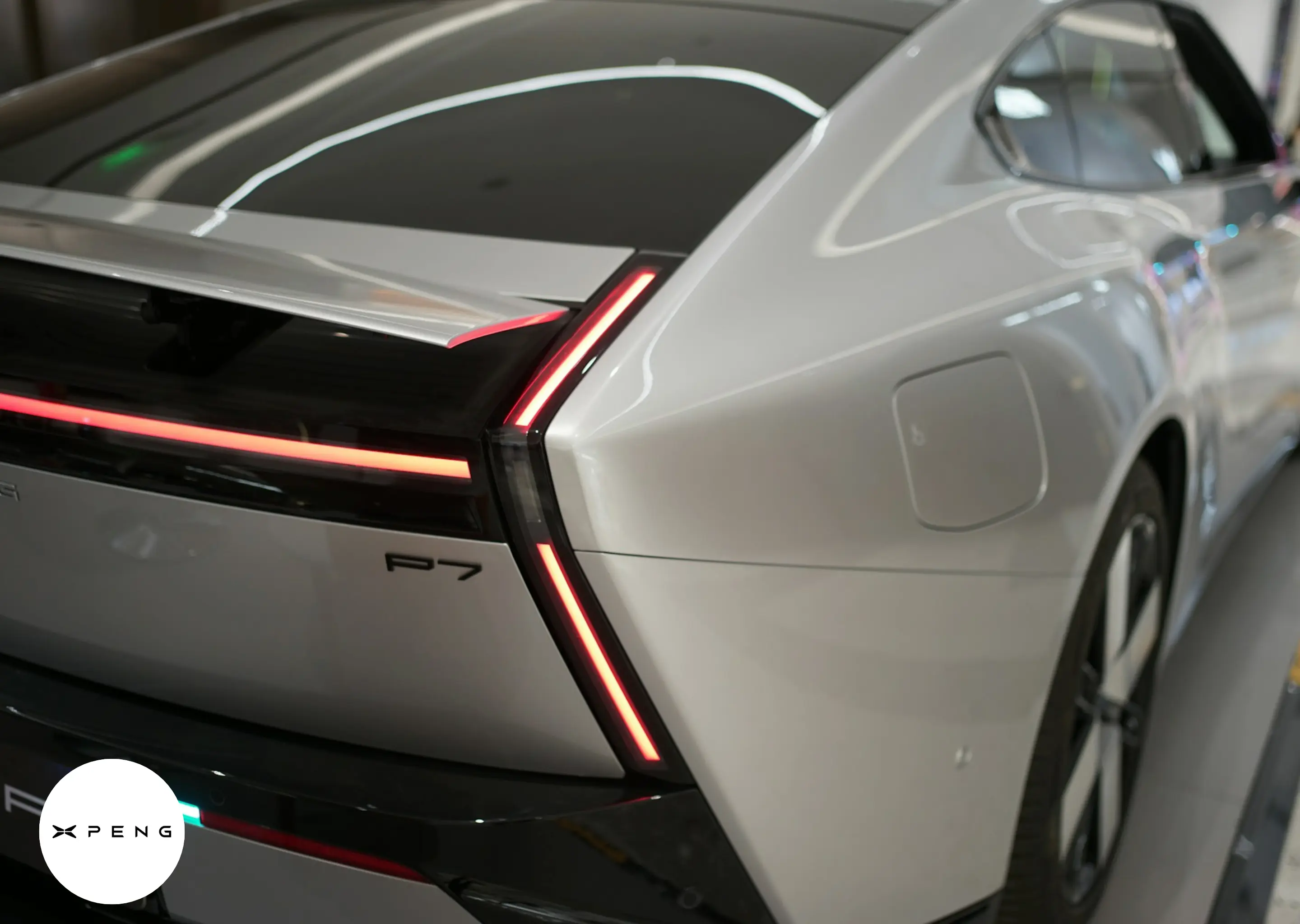
    XPENG is no longer positioned around a narrow premium BEV lineup. Its lineup now spans sedans, SUVs, and MPVs, including the MONA M03, P7+, G6, G7, G9, and X9 families. The portfolio now includes both BEV and EREV offerings in key nameplates such as the P7+, G6, G7, and X9, while much of the range is built around 800V SiC architecture and 5C ultra-fast charging. That widens XPENG’s addressable market because it serves both buyers focused on pure EV economics and buyers who still prioritize extended range.

XPENG’s market position improved sharply through 2025 and into early 2026. The company delivered 429,445 vehicles in 2025, up 125.9% year over year, generated RMB 76.72 billion in revenue, lifted full-year gross margin to 18.9%, and recorded its first quarterly net profit in Q4 2025. In Q1 2026, deliveries reached 62,682 vehicles, and April added another 31,011. XPENG also delivered 45,008 vehicles overseas in 2025, expanded its footprint to 60 countries and regions by year-end, and entered Mexico in March 2026 as part of a broader Latin America strategy. Taken together, XPENG now looks less like a niche smart EV challenger and more like a scaled Chinese EV player with meaningful software, charging, and channel advantages.

XPENG

Performance in China

China remains XPENG’s core market and the center of its retail, charging, and product rollout. The company states that its operations are mainly conducted in the PRC and that its revenue has historically been sourced primarily from the PRC. By the end of 2025, XPENG had built a sales network of 721 stores across 255 cities in China and a self-operated charging network of 3,159 stations, with its S4 and S5 supercharging stations covering 222 cities.

In early 2026, domestic demand stayed strong. XPENG delivered 62,682 vehicles in Q1 2026, including 27,415 in March, then 31,011 in April. Its China lineup now reaches a broader customer base through models such as the MONA M03, P7+ and P7+ EREV, G6, G9, and X9, which gives XPENG exposure to both pure EV buyers and range-extended buyers. The March rollout of VLA 2.0 also improved retail conversion, with test-drive satisfaction rising and the average time from test drive to purchase falling 44.7% month over month by the end of April. Competition remains intense, with foreign and domestic EV brands pushing hard on price, software, and charging convenience in China.

Key strategic drivers in China include:

  1. Dense offline and charging coverage
    A wider store and charging footprint improves customer reach, after-sales support, and brand visibility in lower-tier as well as top-tier cities.
  2. Broader portfolio across price points
    XPENG is no longer tied to one narrow premium niche. The MONA, P7+, G-series, and X9 lineup gives it better coverage of China’s middle-class and mid-to-high-end EV demand.
  3. Software as a sales lever
    XPENG’s intelligent driving system is not only a product feature. It is becoming a retail conversion tool inside China’s stores, which strengthens differentiation in a crowded market.

Growth and Future Prospects

XPENG entered 2026 from a stronger base than it had a year earlier. In 2025, the company delivered 429,445 vehicles, up 125.9% year over year, while total revenue rose to RMB 76.72 billion and full-year gross margin improved to 18.9%. In Q4 2025, XPENG recorded its first quarterly net profit, at RMB 0.38 billion, and ended the year with a cash position of RMB 47.66 billion. That matters because XPENG is still in expansion mode and needs capital for product launches, software development, and overseas growth.

The first published numbers for 2026 show that the momentum carried into the new year. XPENG delivered 62,682 vehicles in Q1 2026, which landed inside its prior guidance range of 61,000 to 66,000, and then delivered 31,011 vehicles in April. The latest operating update also showed that after the March rollout of VLA 2.0, the average time from test drive to purchase decision fell 44.7% month over month by the end of April, which suggests XPENG’s software stack is becoming a direct sales driver rather than only a product feature.

Key growth drivers include:

  1. A broader product cycle across BEV and EREV
    In January 2026, XPENG upgraded the P7+, G6, and G9, and launched the EREV versions of the G7 and P7+. In March, it launched the G6 EREV. In April, it upgraded the MONA M03 and started the presale of the GX. This wider lineup gives XPENG better coverage across price points and customer preferences in China’s EV market.
  2. Software-led differentiation
    XPENG continues to invest heavily in in-house intelligent driving and vehicle software. The company began the gradual rollout of VLA 2.0 in March 2026, and management has linked that system directly to stronger showroom conversion. This supports XPENG’s position as a smart EV maker rather than a price-led hardware seller.
  3. International expansion with local manufacturing support
    XPENG entered Mexico in March 2026 and laid out a three-year Latin America strategy that includes both BEV and EREV launches in 2027. In Europe, the first locally produced P7+ rolled off Magna’s line in Austria in April 2026, following the G6 and G9. This approach gives XPENG a clearer path to overseas scale and lowers part of the friction tied to shipping fully built vehicles from China.
  4. Scale and platform leverage
    XPENG’s new Wuhan manufacturing base had completed construction by March 31, 2026, and the company continues to build around a multi-model platform strategy. That supports faster refresh cycles, broader model coverage, and better absorption of R&D and manufacturing costs across higher volumes.

Challenges ahead include:

  1. Aggressive price competition in China
    XPENG states in its 2025 annual report that competition in smart EVs and NEVs is intensifying, with clear pressure on pricing, sales, and profitability. That remains the biggest near-term risk to margin durability.
  2. Trade barriers in overseas markets
    XPENG’s international push faces higher policy risk. Its 2025 annual report notes that cooperating Chinese EV exporters, including XPENG, are subject to an additional 20.7% EU countervailing duty, while broader tariff and trade-policy uncertainty remains high.
  3. Rising regulatory complexity
    As XPENG expands software functions, overseas operations, and EREV models, it faces a wider set of rules around cybersecurity, data compliance, sustainability, and emissions-related certification. That adds cost and execution pressure at the same time the company is scaling.

Overall, XPENG’s growth story in 2026 is shifting from pure volume recovery to a broader investment case built on product expansion, smarter software, improving profitability, and overseas execution. The next major proof points are a sustained margin profile, stronger overseas mix, and confirmation in the eventual Q1 2026 full earnings release that the delivery momentum is translating into revenue and profit quality.

This Company Profile was written by Dominik Diemer

Dominik Diemer blends an investor mindset with execution discipline.

He is a SAFe Program Consultant (SPC) and Lean Portfolio Management (LPM) practitioner at DMG MORI Digital, working as a SAFe Release Train Engineer and internal consultant in the Lean-Agile Center of Excellence (LACE).

His focus is prioritization, flow, and dependency management that turns strategy into outcomes. With experience across Bertelsmann and the Founders Foundation, he bridges corporate and startup thinking.

He also invests privately in private equity deals, sharpening his view on business models, value drivers, and go-to-market.

StockCounterParts reflects that lens.