Last Updated -

April 15, 2026

ASML

Company Profile and Market Insights

Explore the business model, global strategy, and market performance including insights into its position in China.

ASML
Key facts
Founded 1984 • Euronext Amsterdam & NASDAQ: ASML • Q1 2026 results (reported Apr 15, 2026)
€8.77bn
Total net sales (Q1 2026)
€2.76bn
Net income (Q1 2026)
€2.49bn
Installed Base Management sales (Q1 2026)
53.0%
Gross margin (Q1 2026)
67
New lithography systems sold (Q1 2026)
12
Used lithography systems sold (Q1 2026)

About

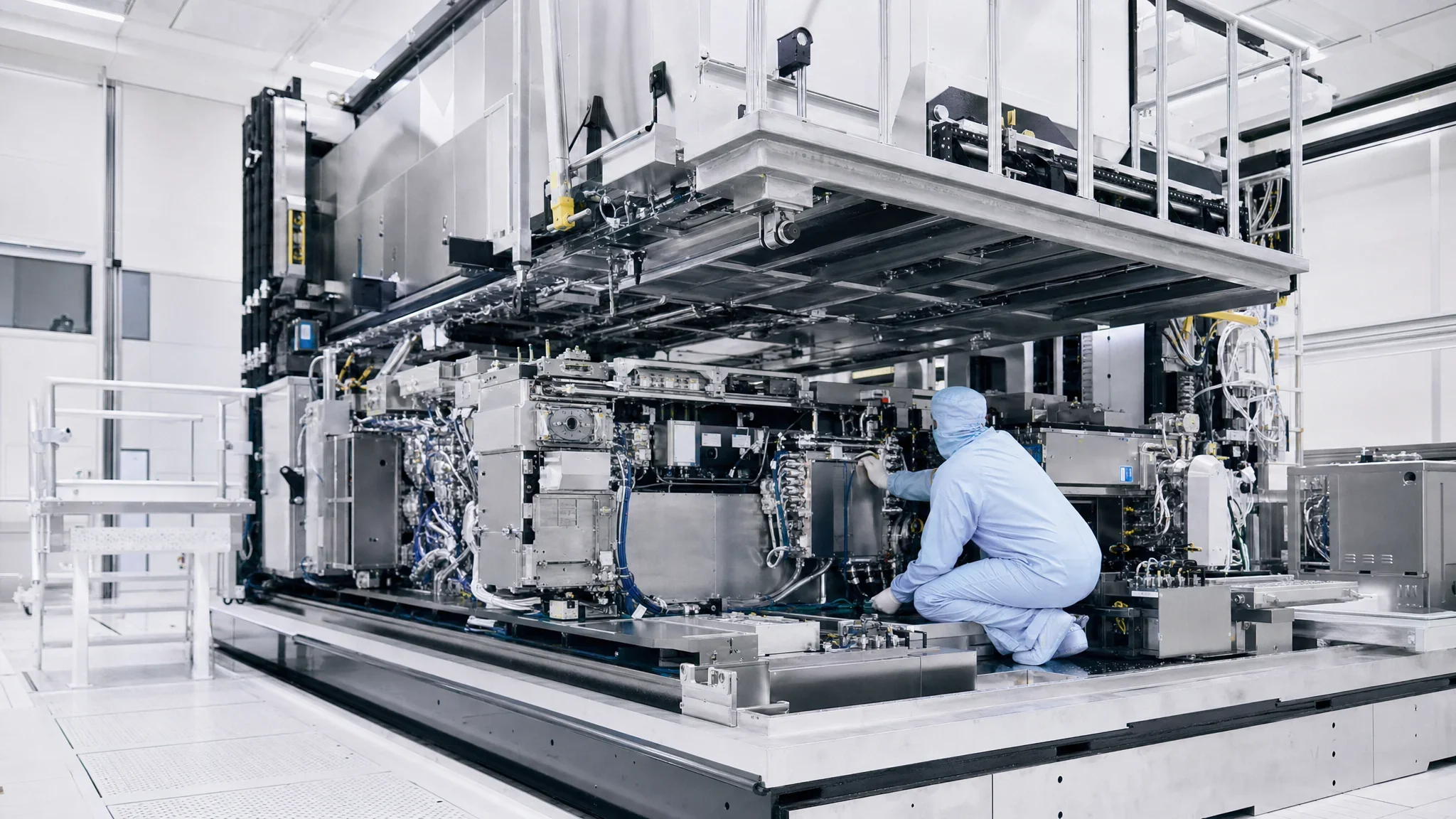
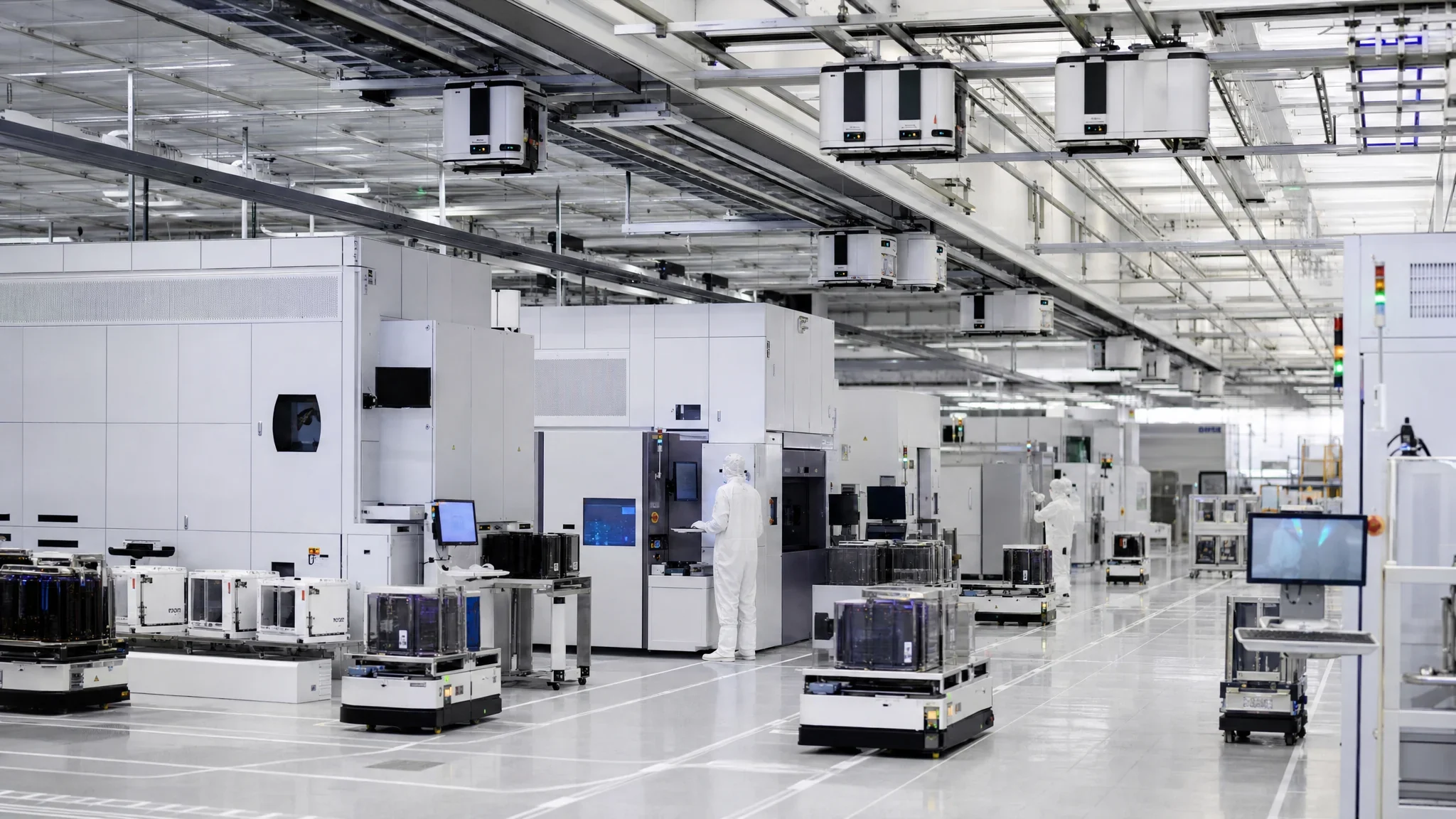
Founded in 1984 as a joint venture between Philips and ASM International, ASML is headquartered in Veldhoven, the Netherlands. The company builds lithography systems, the machines that project circuit patterns onto silicon wafers so chipmakers can manufacture semiconductors at scale. Over time, ASML expanded from hardware into software, metrology, inspection, and service, giving customers a broader toolkit for advanced chip production. ASML now employs more than 44,000 people across more than 60 locations worldwide.

ASML sits at the center of the semiconductor supply chain because its tools support both logic and memory production, especially at advanced process nodes. In 2025, the company generated €32.7 billion in net sales and invested €4.7 billion in R&D, reflecting its focus on next-generation EUV systems and a growing installed base service business. ASML describes its mission as advancing microchip technology with partners and treating technology as a force for good. In its April 2026 update, the company reported €8.8 billion in first-quarter sales and raised full-year 2026 guidance to €36 billion to €40 billion as AI-driven chip demand continued to support customer expansion plans.

ASML

Business Model and Market Position

ASML generates revenue from a mix of new lithography system sales, software and metrology tools, and a growing installed base business built on service, field upgrades, and refurbishment. In 2025, ASML reported €24.5 billion in net system sales and €8.2 billion in net service and field option sales, with service revenue rising 26.2% year over year. That mix matters because it ties ASML’s growth to both new fab investments and the long operating life of machines already in customer fabs. Almost every lithography system ASML has ever shipped is still in use, which supports recurring revenue from maintenance, productivity upgrades, and reuse across mature-node manufacturing.

  1. Lithography systems
    ASML’s core business is selling EUV and DUV lithography tools to leading logic and memory manufacturers. EUV systems handle the most advanced layers in high-volume chip production, while DUV systems remain essential across advanced and mainstream nodes. ASML’s product portfolio is designed to support customer roadmaps across both leading-edge and mature process technologies.
  2. Holistic lithography, software, metrology and inspection
    ASML no longer sells stand-alone exposure tools alone. Its model increasingly centers on “holistic lithography,” which combines scanners, computational lithography, metrology, inspection, and data-driven process control to improve yield, overlay accuracy, and cost per wafer. This broadens ASML’s role inside the fab and raises switching costs for customers once workflows are built around its integrated stack.
  3. Installed base management
    The installed base has become a larger profit engine. ASML has around 10,000 customer support employees worldwide and runs a 24/7 support model focused on uptime, upgrades, and lifecycle extension. In Q1 2026 alone, Installed Base Management sales reached €2.5 billion, showing how recurring revenue is scaling alongside the number of systems already deployed.
  4. System integration and ecosystem control
    ASML operates as a system architect and integrator rather than a fully self-contained manufacturer. It works closely with suppliers and research partners to assemble highly complex machines, while keeping control over the lithography roadmap, platform architecture, and customer integration layer. That structure helps ASML preserve technical leadership without owning every part of the value chain.

ASML’s market position remains exceptional. The company states that it is currently the world’s only manufacturer of EUV lithography systems, giving it a monopoly in the most advanced patterning step of semiconductor manufacturing. In DUV, ASML says its immersion systems lead the industry in productivity, imaging, and overlay performance. That combination gives ASML a rare position: monopoly supplier at the leading edge, dominant supplier across large parts of the broader lithography market, and a critical partner to the top chipmakers’ long-term capacity plans. ASML’s Q1 2026 update, which lifted full-year sales guidance to €36 billion to €40 billion, shows that this position remains intact as AI-related chip demand drives new fab investment and more upgrades of the installed base.

ASML

Performance in China

China remains one of ASML’s most important regional markets, though the revenue mix has become more concentrated in DUV systems, service, training, and local support activities rather than the most advanced EUV layers. In the first half of 2025, ASML recorded €3.7 billion in net sales in China, down from €4.8 billion in the same period of 2024, which points to normalization after an unusually strong 2024 comparison base. Even so, ASML’s CFO said the company’s DUV business in China was stronger than anticipated in 2025, offsetting weaker mainstream DUV demand outside China.

ASML’s strategy in China is centered on customer support and local capability building. The company highlights fast-growing customer support operations in China, computational lithography software development in Shenzhen, e-beam metrology and inspection manufacturing in Beijing, and a DUV training center in Shanghai for both ASML engineers and customer teams. This matters because ASML’s position in China depends not only on tool shipments, but also on uptime, productivity upgrades, and process know-how inside customer fabs.

Looking into 2026, management said China’s share of total net sales should track the current system backlog at around 20%. That suggests China remains a large and durable market for ASML, but not the main driver of its EUV-led growth story, which is tied more closely to advanced logic and DRAM capacity expansion outside China. ASML also said its 2026 guidance range includes the possible outcomes of ongoing export control discussions, which keeps China important but strategically constrained.

Growth and Future Prospects

ASML enters 2026 with stronger momentum than it had at the start of the year. After reporting €32.7 billion in net sales for 2025 and ending the year with a backlog of about €38.8 billion, management raised full-year 2026 sales guidance to €36 billion to €40 billion after Q1 2026. The company tied that stronger outlook to AI infrastructure spending, faster capacity expansion by advanced logic and DRAM customers, and rising upgrade and service demand from machines already installed in fabs. Installed Base Management sales reached €2.488 billion in Q1 2026, which shows that growth is coming from both new systems and the installed base.

Key growth drivers include:

  1. AI-led demand in advanced logic and memory
    ASML expects AI to push the industry mix toward advanced logic and DRAM, the two segments with the highest lithography intensity. In its 2030 framework, the company still projects semiconductor market growth of 9% CAGR from 2025 to 2030, to more than $1 trillion, with EUV lithography spending CAGR of 10% to 20% in advanced logic and 15% to 25% in DRAM.
  2. High NA EUV commercialization
    High NA remains the central product cycle for ASML’s next growth phase. By the end of 2025, customers had processed more than 400,000 wafers on High NA EUV systems, and ASML said its TWINSCAN EXE platform is expected to support high-volume manufacturing in 2027. That keeps ASML tightly linked to the next wave of leading-edge process migrations.
  3. Installed base upgrades and service expansion
    Recurring revenue is becoming a larger part of the story. ASML reported Installed Base Management sales of €8.2 billion in 2025, up 26% from 2024, and said it expects another year of growth in service and field option sales in 2026, driven by a larger EUV installed base and customer demand for productivity upgrades.
  4. Broader exposure beyond scanners
    ASML’s growth case no longer depends on lithography tool shipments alone. Metrology and inspection system sales rose 28% to €825 million in 2025, and the company’s €1.3 billion investment in Mistral AI for an approximately 11% fully diluted stake is intended to improve products, research, development, operations, and time-to-market across its portfolio.

Challenges ahead include:

  1. Export controls and geopolitics
    ASML stated that changes in export controls can materially affect sales volume, sales mix, and shipment timing. Its April 2026 guidance range already includes possible outcomes from ongoing export control discussions, which means regulation remains a direct variable in the near-term outlook.
  2. Capacity scaling and execution risk
    ASML is still expanding production capacity across its supply chain, though the company also flags real execution risks. These include supplier investment needs, hiring constraints, permit timing, industrialization challenges, and the risk that new product introductions fall behind schedule if R&D execution slips.
  3. Cyclicality and competition
    Even with EUV leadership, ASML is not insulated from industry cycles. The company states that semiconductor equipment demand remains cyclical, that a small number of high-value system shipments still has a large effect on results, and that it faces direct competition from Canon and Nikon in DUV as well as competition from Applied Materials and KLA in applications tied to complex patterning and process control.

ASML’s future growth rests on three pillars: AI-driven lithography intensity, High NA EUV adoption, and a larger installed base that generates more service and upgrade revenue. The main constraints are export controls, capacity execution, and the semiconductor cycle. Management’s 2030 framework, which still points to a revenue opportunity of roughly €44 billion to €60 billion, shows that ASML still sees a multi-year runway well beyond the current upcycle.

This Company Profile was written by Dominik Diemer

Dominik Diemer blends an investor mindset with execution discipline.

He is a SAFe Program Consultant (SPC) and Lean Portfolio Management (LPM) practitioner at DMG MORI Digital, working as a SAFe Release Train Engineer and internal consultant in the Lean-Agile Center of Excellence (LACE).

His focus is prioritization, flow, and dependency management that turns strategy into outcomes. With experience across Bertelsmann and the Founders Foundation, he bridges corporate and startup thinking.

He also invests privately in private equity deals, sharpening his view on business models, value drivers, and go-to-market.

StockCounterParts reflects that lens.