Last Updated -

February 16, 2026

Crocs

Company Profile and Market Insights

Explore the business model, global strategy, and market performance including insights into its position in China.

Crocs
Key facts
Founded 2002 β€’ IPO Feb 2006 β€’ Nasdaq: CROX
$4.041B
Revenue (FY 2025)
22.3%
Adjusted operating margin (FY 2025)
$12.51
Adjusted diluted EPS (FY 2025)
$958M
Revenue (Q4 2025)
$2.29
Adjusted diluted EPS (Q4 2025)
$12.88 to $13.35
Adjusted diluted EPS outlook (FY 2026)

About

Founded in 2002 and headquartered in Broomfield, Colorado, Crocs, Inc. is a global casual footwear company best known for its molded clog silhouette and lightweight resin-based comfort designs. Β The group operates two brands, Crocs and HEYDUDE, spanning clogs, sandals, and relaxed everyday shoes, with a strong focus on repeatable core styles and seasonal color updates.

‍

Crocs sells through a mix of wholesale partners and direct-to-consumer channels, including owned retail and e-commerce. Its products are sold in more than 85 countries, with international markets representing a major growth engine for the Crocs Brand.

‍

On February 12, 2026, the company reported full-year 2025 consolidated revenue of $4.041 billion, including $3.326 billion from the Crocs Brand and $715 million from HEYDUDE. Β The Crocs Brand generated $1.616 billion of revenue internationally in 2025, while the company reported operating cash flow of about $700 million for the year.

Crocs

Business Model and Market Position

Crocs, Inc. earns revenue through two brands, Crocs and HEYDUDE, selling casual footwear and related accessories through wholesale partners and direct-to-consumer channels. The company designs and markets its products while relying on a globally diversified third-party manufacturing base, with Crocs Brand production concentrated in Vietnam and HEYDUDE Brand production concentrated in China in recent years.

‍

How Crocs makes money

‍

  1. Crocs Brand footwear and accessories
    The core franchise is molded footwear built around Croslite, a proprietary closed-cell resin material that supports high-volume production in a limited set of hero silhouettes and frequent color updates.
    ‍
  2. Personalization and add-ons
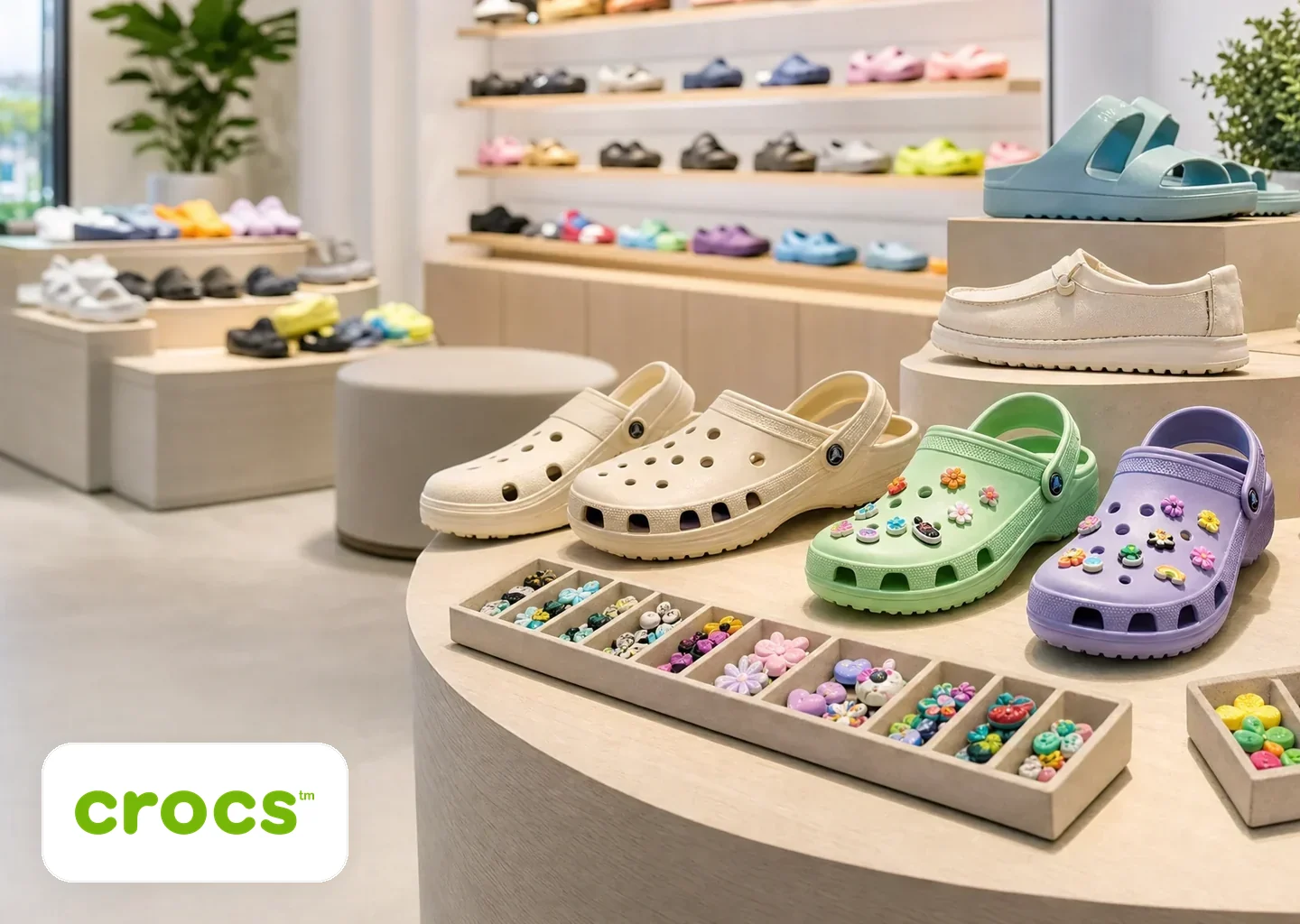
    Jibbitz charms and other accessories reinforce repeat purchases and raise basket size, supported by frequent collaborations and themed drops.
    ‍
  3. HEYDUDE casual shoes
    HEYDUDE targets lightweight slip-on comfort shoes, sold mostly in North America, with a channel reset underway after wholesale weakness. In 2025, HEYDUDE revenue fell to $715 million, driven by a sharp wholesale decline.
    ‍

Channel structure

‍

Crocs sells through wholesale (multi-brand retailers, mono-branded partner stores, e-tailers, distributors) and DTC (company-operated stores, brand sites, third-party marketplaces).
‍

Based on today’s full-year 2025 segment breakdown, DTC represented about 52.1% of consolidated revenue ($2.105 billion of $4.041 billion), with wholesale at about 47.9%. Crocs Brand DTC was about 51.9% of brand revenue, while HEYDUDE Brand DTC was about 53.0%.
‍

Market position
‍

Crocs sits in the global comfort and casual footwear category with a distinct identity anchored in molded clogs and personalization. In 2025, the Crocs Brand stayed in growth at $3.326 billion, with international revenue of $1.616 billion offsetting a weaker North America result.
‍

The financial model reflects this positioning. For 2025, the company reported 58.3% gross margin and 22.3% adjusted operating margin, supported by scale in core product families and a DTC mix above 50%.

Crocs

Performance in China

China sits at the center of Crocs’ international growth story. In its February 12, 2026 results release, Crocs reported 2025 Crocs Brand international revenue of $1.616 billion, up 11.9% year over year, and Q4 international revenue of $332 million, up 14.1%.

‍

Management put China’s momentum into concrete terms on the Q4 2025 earnings call. Crocs described China as its second-largest market, with 2025 revenue growth of 30% on top of 64% growth in 2024, and China representing about 8% of sales. Β The company also highlighted a strong Double Eleven shopping festival and linked part of the acceleration to line clog demand.

‍

What is driving results

‍

  1. Channel mix built for China’s digital retail
    Crocs leans into marketplace and social commerce behavior. A February 2026 China market analysis described Crocs as selling through platforms such as Taobao, JD.com, Douyin shopping, plus fast delivery options like Meituan, alongside a dense physical network.
    ‍
  2. Store footprint and brand-controlled execution
    The same analysis cited over 400 direct and partner retail locations in China. Crocs has also emphasized expanding its international footprint, ending 2025 with about 2,600 Crocs mono-branded stores and kiosks globally and planning 200 to 250 additional openings internationally in 2026.
    ‍
  3. Product-market fit and personalization
    China demand skews toward the Classic Clog and fashion-led platform versions, with Jibbitz personalization acting as a repeat-purchase engine. Local collaborations and seasonal launches, including China-specific themes, reinforce that behavior.
    ‍

What it implies for runway

‍

Crocs framed China as an underpenetrated profit pool. On the same call, management said its average market share across China and several other growth markets stands at about one-third of its share in established markets, which supports the case for sustained multi-year expansion if execution stays consistent.

Growth and Future Prospects

Crocs enters 2026 with a plan built around international expansion, DTC execution, and a reset at HEYDUDE. Management guides 2026 enterprise revenue to be down about 1% to up slightly versus 2025. It guides the Crocs Brand to be flat to up 2%, and HEYDUDE to be down about 7% to 9%. Adjusted diluted EPS guidance is $12.88 to $13.35, alongside modest adjusted operating margin expansion from 22.3% in 2025.

‍

The year starts softer. For Q1 2026, Crocs expects revenue down about 5.5% to 3.5% year over year, with the Crocs Brand down low single digits and HEYDUDE down 15% to 18%. Q1 adjusted diluted EPS guidance is $2.67 to $2.77.

‍

Key growth drivers include

‍

  1. International growth led by China and Asia
    Crocs described China as its second-largest market, with 2025 China revenue up 30% on top of 64% in 2024, and China at about 8% of sales. For 2026, management spoke about an outlook that includes around 10% international growth for the Crocs Brand, offset by declines in North America.
    ‍
  2. More stores and tighter brand control outside North America
    Crocs ended 2025 with about 2,600 mono-branded stores and kiosks and plans to open 200 to 250 stores internationally in 2026, across tier-one markets and distributor markets.
    ‍
  3. DTC and social commerce execution
    Management expects DTC to outperform wholesale and improve through the year, with continued focus on digital and social commerce in key markets.
    ‍
  4. Cost savings and supply chain work
    Crocs said it has identified and actioned $100 million of cost savings for 2026, split between cost of goods sold and SG&A, plus supply chain optimization. The press release also guides about $25 million of discrete non-GAAP costs tied to supply chain optimization and other efficiency actions.
    ‍
  5. HEYDUDE turnaround path
    Guidance assumes a year-over-year decline in 2026, with management pointing to a return to growth in the second half of 2026 as wholesale cleanup and channel resets anniversary.
    ‍

Challenges and watch items
‍

  1. Tariffs and gross margin pressure
    Management cited tariff headwinds in 2025 margins and guided about 80 bps of incremental tariff pressure for 2026, plus an unmitigated tariff headwind of about $80 million on an annualized basis at current rates and sourcing mix. It also flagged heavier quarterly pressure early in the year.
    ‍
  2. North America demand and channel mix
    The 2026 shape implies international growth offset by North America declines, tied to actions taken in the second half of 2025 and tougher comparisons in 2026.
    ‍
  3. Execution risk at HEYDUDE
    HEYDUDE revenue fell to $715 million in 2025, with wholesale down sharply. The recovery depends on cleaner inventory, healthier assortments, and wholesale re-acceleration later in 2026.
    ‍

Capital allocation stays central. In 2025, Crocs generated $659 million of free cash flow, repurchased 6.5 million shares for $577 million, and ended the year with $747 million remaining under its repurchase authorization. The company also repaid $128 million of debt, and guides $70 million to $80 million of capex for 2026.

This Company Profile was written by Dominik Diemer

Dominik Diemer blends an investor mindset with execution discipline.

He is a SAFe Program Consultant (SPC) and Lean Portfolio Management (LPM) practitioner at DMG MORI Digital, working as a SAFe Release Train Engineer and internal consultant in the Lean-Agile Center of Excellence (LACE).

His focus is prioritization, flow, and dependency management that turns strategy into outcomes. With experience across Bertelsmann and the Founders Foundation, he bridges corporate and startup thinking.

He also invests privately in private equity deals, sharpening his view on business models, value drivers, and go-to-market.

StockCounterParts reflects that lens.