Last Updated -

February 2, 2026

Nike

Company Profile and Market Insights

Explore the business model, global strategy, and market performance including insights into its position in China.

Key facts
Founded 1964 (Blue Ribbon Sports) • Nike name since 1971 • NYSE: NKE
$46.3B
Revenue FY 2025 (ended May 31, 2025)
$25.9B
NIKE Brand wholesale (FY 2025)
$18.8B
NIKE Direct (FY 2025)
77,800
Employees (May 31, 2025)
$6.6B
Greater China revenue (FY 2025)
543
Factory stores outside the U.S. (May 31, 2025)
Nike

About

Nike, Inc. began in 1964 as Blue Ribbon Sports, founded by Phil Knight and Bill Bowerman, and adopted the Nike name in 1971. The company is headquartered near Beaverton, Oregon, at the Philip H. Knight Campus, the name Nike announced in October 2025 for its world headquarters site.

NIKE, Inc. is a worldwide leader in the design, development, marketing, and selling of athletic footwear, apparel, equipment, accessories, and services. Its portfolio includes the Nike Brand, Jordan Brand, and Converse, spanning performance sport and sport-inspired lifestyle categories. Nike states its mission as “to bring inspiration and innovation to every athlete in the world,” alongside its line that “if you have a body, you are an athlete.”

The company serves consumers through a mix of direct channels and wholesale partners across global markets, with most revenue coming from outside the United States in recent years. Nike is led by President and CEO Elliott Hill and employed about 77,800 people as of May 31, 2025.

Nike

Business Model and Market Position

Nike generates revenue by designing and marketing athletic footwear, apparel, and equipment under the Nike Brand, Jordan Brand, and Converse, then distributing products through a mix of wholesale partners and its owned retail and digital channels. In fiscal 2025 (year ended May 31, 2025), NIKE, Inc. reported $46.3B in revenue, with NIKE Brand wholesale at $25.9B and NIKE Direct at $18.8B, which represented about 42% of NIKE Brand revenue.

  1. Wholesale distribution at global scale
    Wholesale remains Nike’s largest route to market, providing reach through sporting goods retailers, athletic specialists, and department stores across regions. Recent results show Nike leaning back into wholesale as part of a broader channel reset. In fiscal 2026 Q2 (reported December 18, 2025), wholesale revenue was $7.5B, up 8%, while NIKE Direct declined.
  2. NIKE Direct with owned stores and digital commerce
    NIKE Direct includes Nike-owned stores and Nike Brand Digital, supported by membership and data-driven merchandising. Nike reported digital commerce platforms in 40+ countries and a large non-U.S. store base, including 543 Nike Brand factory stores outside the U.S. as of May 31, 2025. Fiscal 2025 NIKE Direct revenue fell 13% as NIKE Brand Digital sales fell to $9.6B.
    '
  3. Brand-led demand creation and product franchises
    Nike’s model relies on premium brand positioning, seasonal product creation, and sport category storytelling that supports pricing power when inventory is clean. Fiscal 2025 results showed margin pressure tied to higher discounts and channel mix, which highlights how closely profitability tracks product freshness and promotional intensity.
  4. Asset-light manufacturing with concentrated sourcing risk
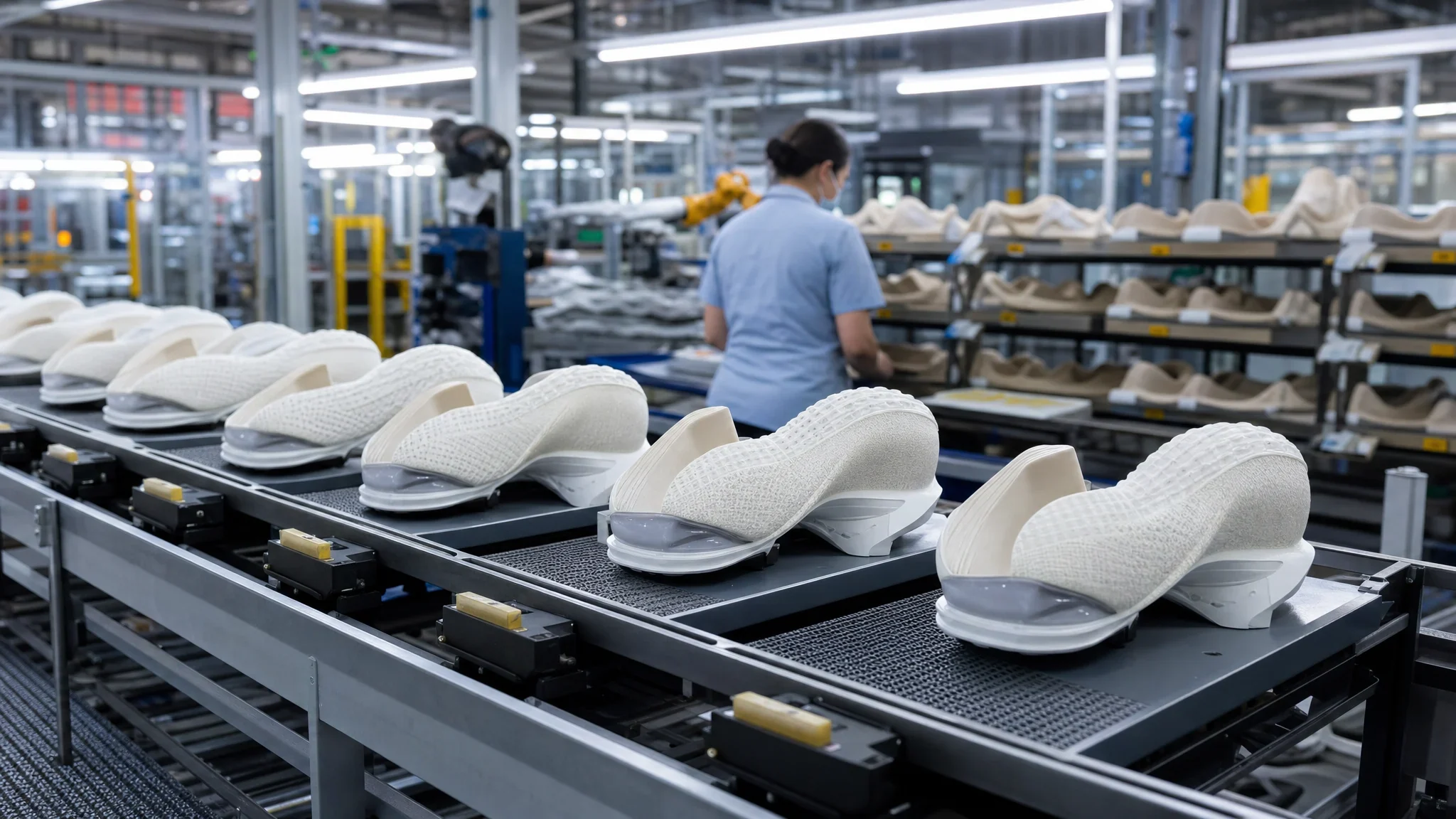
    Nike outsources nearly all manufacturing to independent contract manufacturers. As of May 31, 2025, contract manufacturers operated 97 footwear factories in 11 countries, with Vietnam, Indonesia, and China accounting for the majority of NIKE Brand footwear production. This structure keeps fixed assets low, while making Nike sensitive to tariffs, logistics disruption, and supplier concentration.

Market position

Nike remains one of the most valuable global consumer brands. Interbrand’s 2025 ranking lists Nike with a brand value of $33.7B.  Brand Finance’s 2025 apparel ranking also identifies Nike as the strongest apparel brand by its Brand Strength Index.

The competitive set has intensified, especially in running, where brands like On and Hoka have gained momentum and shelf space.  Nike’s current positioning reflects a shift away from an earlier DTC-heavy approach toward a more balanced marketplace strategy under CEO Elliott Hill (effective October 2024).  That reset includes rebuilding wholesale partnerships and expanding selected digital distribution, including Nike’s return to selling directly on Amazon in the U.S. for the first time since 2019.

Nike

Performance in China

Greater China remains a key profit and brand-building region for Nike, representing about 15% of NIKE, Inc. revenue in fiscal 2025. In fiscal 2025, Nike reported $6.6B in Greater China revenue, down 12% on a currency-neutral basis, with pressure across wholesale and direct. NIKE Direct in the region fell 12%, driven by digital sales down 22% and store sales down 6%, while comparable store sales declined 7%.

The downtrend continued into fiscal 2026. In Q2 fiscal 2026 (ended November 30, 2025), Greater China revenue declined to $1.423B, down 17% reported and 16% currency-neutral. Footwear in the region fell 21%, and Greater China EBIT fell 49%, reflecting weak traffic, higher promotions in the marketplace, and tougher competition.

Key factors shaping Nike’s China performance include:

  1. Store traffic softness and elevated promotions, which pressure full-price sell-through and profitability.
  2. Rising domestic champions like Anta and Li-Ning, increasing price and mindshare competition.
  3. Digital slowdown, with online sales down 36% in the quarter per Reuters reporting, limiting Nike’s ability to offset store weakness.

Nike’s response is a China reset under CEO Elliott Hill, including tighter promotional posture around key moments like Singles Day and retail upgrades in major cities, while pushing harder on sport-focused product and local marketplace execution.

Growth and Future Prospects

Nike’s next phase is built around a sport-led turnaround that prioritizes fresher product, cleaner marketplace execution, and a more balanced channel mix. In fiscal 2026 Q2 (ended November 30, 2025), wholesale revenue rose 8% to $7.5B while NIKE Direct fell 8% to $4.6B, reflecting renewed emphasis on wholesale partners alongside a reset of Nike’s owned digital and store experience.

Key growth drivers include:

  1. Sport-first operating model and faster category iteration
    CEO Elliott Hill reorganized teams by sport (running, basketball, football, training, sportswear) under the “Sport Offense” structure, aiming to sharpen consumer insight and accountability at the category level.
  2. Rebuilt product pipeline and integrated creation teams
    Nike unified Innovation, Design, and Product teams and highlighted new platforms such as Nike Mind, Project Amplify, Aero-FIT, and Therma-FIT Air Milano. The goal is a steadier flow of performance-led newness that supports full-price demand.
  3. Women’s growth with NikeSKIMS
    Nike announced NikeSKIMS with SKIMS in February 2025, targeting training apparel, footwear, and accessories for women, with a broader rollout planned for 2026. Nike later delayed the initial U.S. launch to refine the product.
  4. Sustainability tied to cost, materials, and brand relevance
    Nike reported FY24 progress including 69% reduction in Scope 1 and 2 emissions from operations versus FY20, 96% renewable electricity in global operations, and 100% landfill diversion for operational waste by strategic finished goods suppliers.

Challenges ahead:

  • Margin pressure from tariffs and cleanup actions: Nike cited $1.5B in annualized incremental product costs from higher U.S. tariffs, with near-term impact on gross margin.
  • China recovery: In Greater China, fiscal 2026 Q2 revenue fell 16%, with NIKE Digital down 36%, alongside higher obsolescence tied to aged inventory.
  • Non-core digital bets and legal noise: Nike wound down RTFKT, faced a class action tied to NFT losses, then sold RTFKT in December 2025.

This Company Profile was written by Dominik Diemer

Dominik Diemer blends an investor mindset with execution discipline.

He is a SAFe Program Consultant (SPC) and Lean Portfolio Management (LPM) practitioner at DMG MORI Digital, working as a SAFe Release Train Engineer and internal consultant in the Lean-Agile Center of Excellence (LACE).

His focus is prioritization, flow, and dependency management that turns strategy into outcomes. With experience across Bertelsmann and the Founders Foundation, he bridges corporate and startup thinking.

He also invests privately in private equity deals, sharpening his view on business models, value drivers, and go-to-market.

StockCounterParts reflects that lens.