Tesla’s business model is built around direct sales and leasing of electric vehicles, supported by energy storage, services, software, charging, insurance, solar, and regulatory credits. Automotive remains the core revenue base, while energy storage and services are becoming more important contributors to gross profit and ecosystem revenue.
In Q1 2026, Tesla generated total revenue of $22.387 billion, up 16% year over year. Automotive revenue was $16.234 billion, or about 73% of total revenue, with automotive sales revenue rising 20% to $15.473 billion. Total gross margin improved to 21.1% from 16.3% a year earlier, while net income attributable to common stockholders was $477 million. The result shows a company with large revenue scale and improving gross margin, but still modest net profitability relative to sales because of high R&D, SG&A, stock-based compensation, foreign exchange, and digital-asset mark-to-market effects.
- Automotive: Tesla sells and leases Model 3/Y and other vehicles through a direct-to-consumer model in many markets. Vehicle sales are the main revenue stream, with additional monetization from leasing, Full Self-Driving related deferred revenue, connectivity, software updates, and regulatory credits. Regulatory credit revenue was $380 million in Q1 2026, down 36% year over year, making it a profitable but volatile contributor.
- Services and other: This segment includes used vehicle sales, non-warranty maintenance, collision revenue, paid Supercharging, and automotive insurance. Revenue rose 42% year over year to $3.745 billion in Q1 2026, making it Tesla’s fastest-growing major reported revenue line in the quarter.
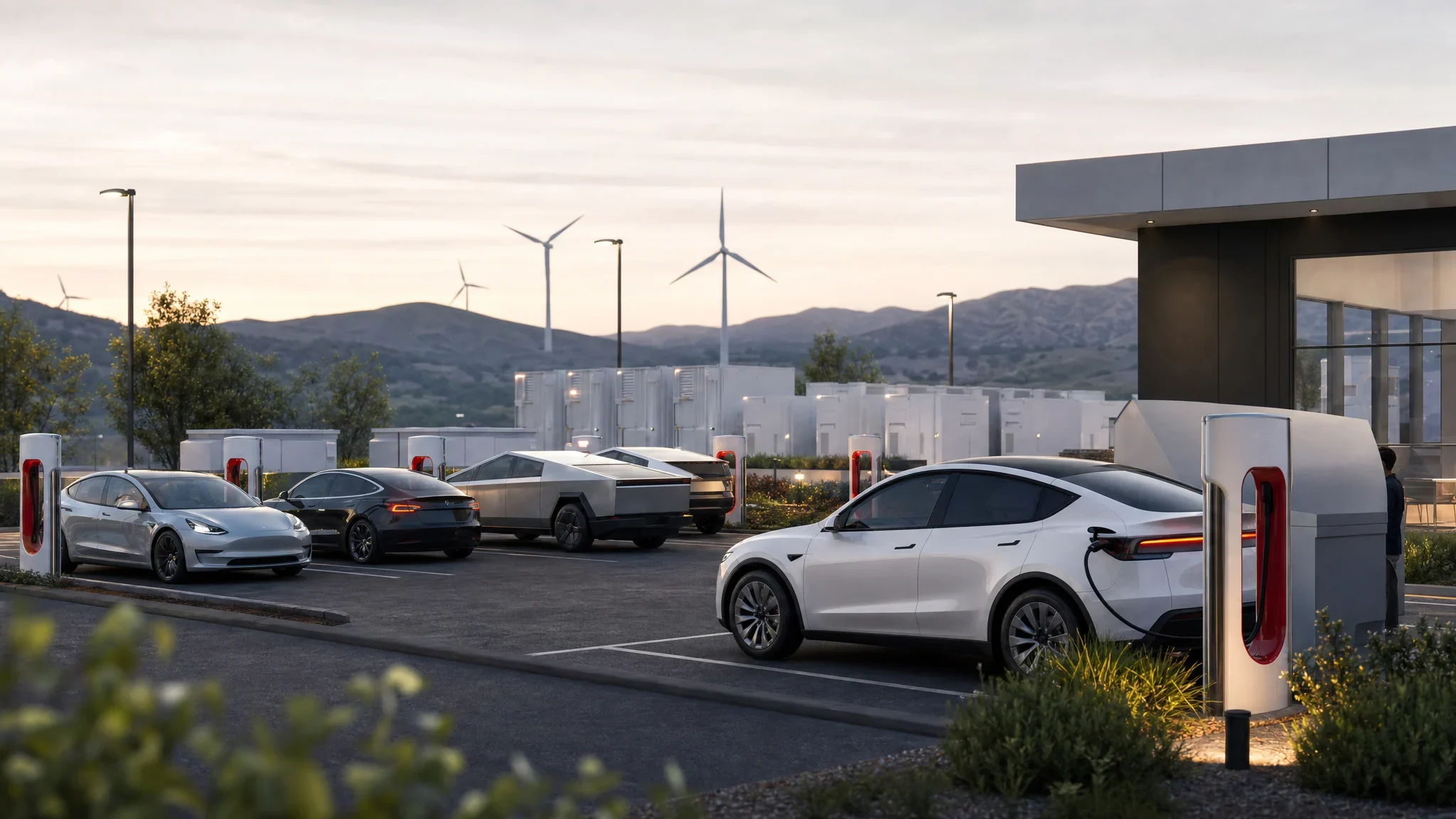
- Energy generation and storage: Tesla sells and leases products such as Megapack, Powerwall, and solar-related offerings. Q1 2026 energy generation and storage revenue fell 12% year over year to $2.408 billion, but segment gross margin improved to 39.5% from 28.8%. Q2 2026 operational data showed 13.5 GWh of energy storage deployments, reinforcing storage as a major growth and margin lever.
Tesla’s competitive advantages come from brand recognition, vertical integration, software development, battery and powertrain know-how, manufacturing scale, Supercharger infrastructure, and a direct customer relationship. The company controls more of the customer experience than most legacy automakers, including sales, service, charging, software updates, insurance, and vehicle data feedback loops. Its balance sheet also supports investment, with $16.603 billion of cash and cash equivalents at March 31, 2026.
Tesla’s market position remains strong but more contested. It is one of the world’s best-known EV brands and a major global EV manufacturer, yet competition has intensified across the U.S., China, and Europe. In Q2 2026, Tesla delivered 480,126 vehicles, with Model 3/Y accounting for 467,762 deliveries. This confirms the company’s continuing dependence on its volume models, especially Model Y, while newer products and higher-end models represent a smaller share of deliveries.
China is central to Tesla’s market position. In 2025, China revenue was $20.962 billion, about 22% of total 2025 revenue, making it Tesla’s second-largest disclosed geographic market after the United States. Tesla operates both Gigafactory Shanghai and Megafactory Shanghai, giving China strategic importance for sales, manufacturing, exports, and energy storage. The same exposure brings regulatory, tariff, currency, data, financing, and local-competition risk.
BYD is Tesla’s most relevant comparison peer because it competes directly in China and global EV and battery markets. BYD has a strong domestic base, broad product range, and battery integration, while Tesla competes with a more software-led, premium global brand position and a larger emphasis on autonomy, charging infrastructure, and AI-driven optionality. Legacy automakers also compete with Tesla across EVs, pricing, dealer networks, financing, and fleet relationships.
Tesla’s investor profile is split between a large, cyclical EV manufacturing business and longer-duration options in Full Self-Driving, robotaxi, AI infrastructure, and Optimus robotics. Q1 2026 R&D expense rose 38% year over year to $1.946 billion, reflecting heavy investment in AI and product-roadmap priorities. For private investors, the key question is whether Tesla’s automotive and energy businesses generate enough durable cash flow to fund these investments while competition pressures vehicle pricing and margins.