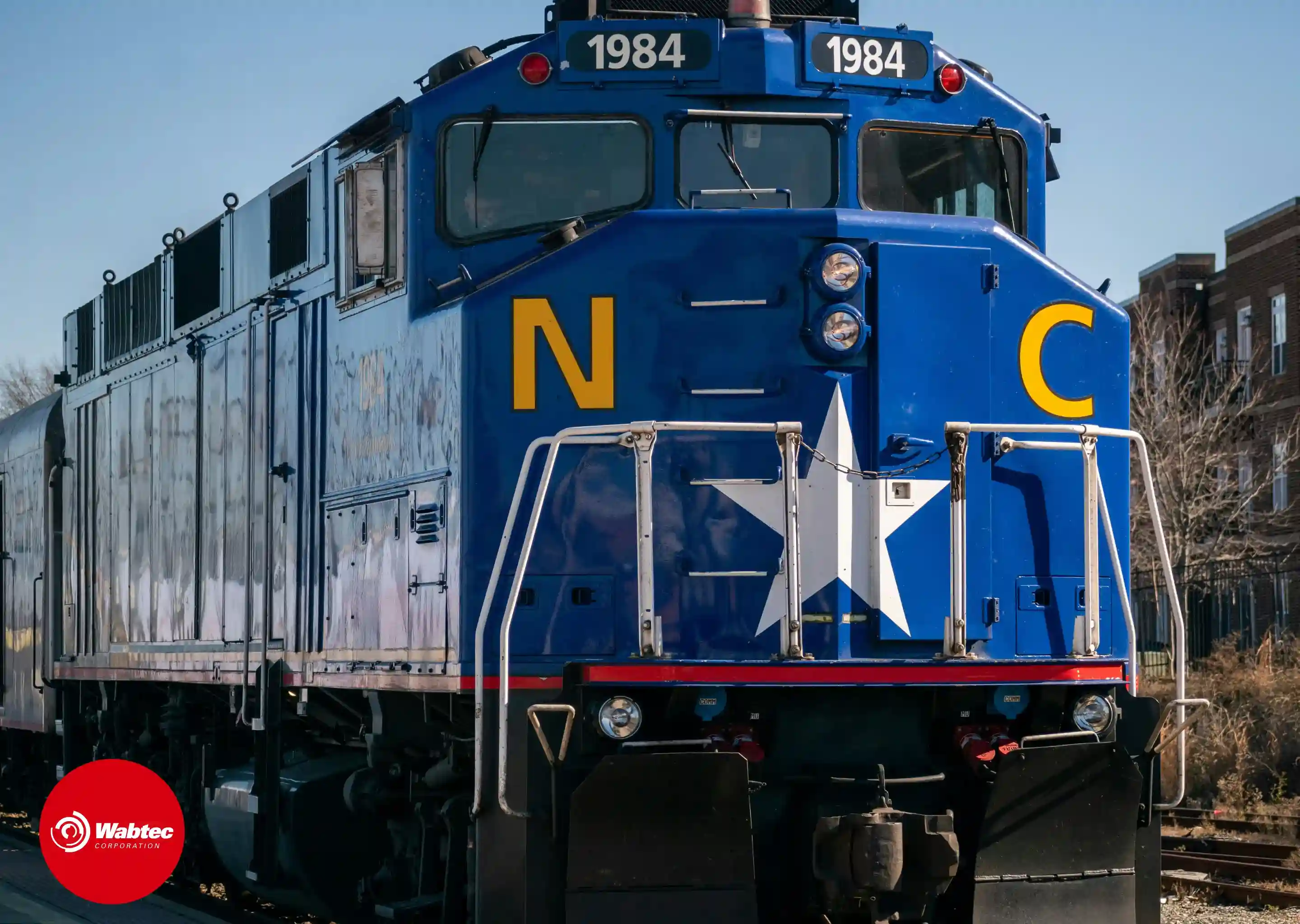
Wabtec makes money by selling rail equipment, components, digital systems, aftermarket parts and long-cycle services to freight railroads, passenger transit operators, mining customers and related industrial markets. Its model combines original equipment sales with recurring service, modernization, overhaul, remanufacturing and replacement-parts revenue from a large installed base of nearly 24,600 locomotives in service.
The company operates through two reportable segments
- Freight: The largest business, with $8.04 billion of 2025 sales, or about 72% of total net sales. Freight includes locomotives, freight-car products, braking and control systems, components, digital intelligence, inspection technologies and services. About 58% of Freight sales came from aftermarket activities in 2025, giving the segment a recurring revenue base tied to fleet maintenance and modernization.
- Transit: A passenger rail and bus components business, with $3.13 billion of 2025 sales, or about 28% of total net sales. Transit sells components and services for passenger rail vehicles, regional trains, high-speed trains, subway cars, light-rail vehicles and buses. About 56% of Transit sales were aftermarket in 2025.
Wabtec’s main product and service categories include Freight Services, Equipment, Components, Digital Intelligence, Transit OEM and Transit Aftermarket. In 2025, Freight Services was the largest product line at $3.06 billion of sales, followed by Equipment at $2.37 billion, Transit Aftermarket at $1.74 billion, Components at $1.59 billion, Transit OEM at $1.39 billion and Digital Intelligence at $1.03 billion.
The business entered 2026 with strong demand visibility. Q1 2026 sales were $2.95 billion, up 13.0% year over year, with adjusted operating margin of 21.9%. Multi-year backlog reached $30.80 billion at March 31, 2026, up $8.50 billion year over year, and 12-month backlog increased 12.8%. Management kept 2026 revenue guidance at $12.19 billion to $12.49 billion and raised adjusted EPS guidance to $10.25 to $10.65.
Wabtec’s competitive advantages come from scale, installed base, breadth of rail technologies and long customer relationships. Its equipment and service footprint gives it access to recurring demand as locomotives and transit fleets require maintenance, replacement parts, upgrades and regulatory compliance work over many years. Recent acquisitions also expanded the portfolio into inspection technologies, train detection, wayside object control, axle counting and safety-critical couplers.
The company has a leading global position in freight rail and passenger transit supply, with customers across North America, Europe, Asia Pacific, Africa and South America. North America remains the core market, with $6.19 billion of 2025 sales by destination. Europe contributed $1.96 billion, followed by India, Australia/New Zealand, Kazakhstan/CIS, Africa, Other Asia/Middle East and China.
Direct competitors include Progress Rail in locomotives, Knorr-Bremse and its New York Air Brake business in braking systems, Amsted Rail in freight components, CRRC in selected geographies and product lines, local suppliers and in-house railroad or transit authority operations. Compared with Progress Rail, Wabtec has a broader public-company profile across freight equipment, transit components, digital systems and aftermarket services. Compared with CRRC, Wabtec has a much smaller China-centered exposure and a more North America-led revenue base.
China is present but not central to the investment case. Wabtec generated $297 million of 2025 sales to China, about 2.7% of total company sales. The company has operations and facilities in China, and Chinese certification requirements matter for products sold there, but China is a modest destination market relative to North America, Europe, India, Kazakhstan/CIS and broader global rail opportunities.
Customer concentration is manageable for a capital equipment supplier. No single customer represented 10% or more of 2025 consolidated net sales, while the top five customers accounted for about 30%. This reduces dependence on one buyer, although demand still depends on freight rail capital spending, transit authority budgets, passenger rail funding, mining activity and the timing of large locomotive and infrastructure projects.