Credo Technology is a fabless semiconductor and connectivity company focused on high-speed data movement inside AI infrastructure, cloud data centers, hyperscale networks, enterprise/HPC systems and optical networking. The company outsources wafer manufacturing and most back-end production while concentrating its own resources on chip design, systems engineering, product qualification, customer engagement and connectivity platforms.
Credo’s revenue model is centered on product sales, with a smaller contribution from IP licensing. In Q1 FY2026, product sales were $217.1 million and IP license revenue was $6.0 million. By Q4 FY2026, total revenue reached $437.0 million, up 157.0% year over year, and full-year FY2026 revenue was $1.335 billion, up 205.7% from FY2025. The company guided Q1 FY2027 revenue to $465 million to $475 million, indicating continued sequential growth from Q4.
Key revenue and product categories include
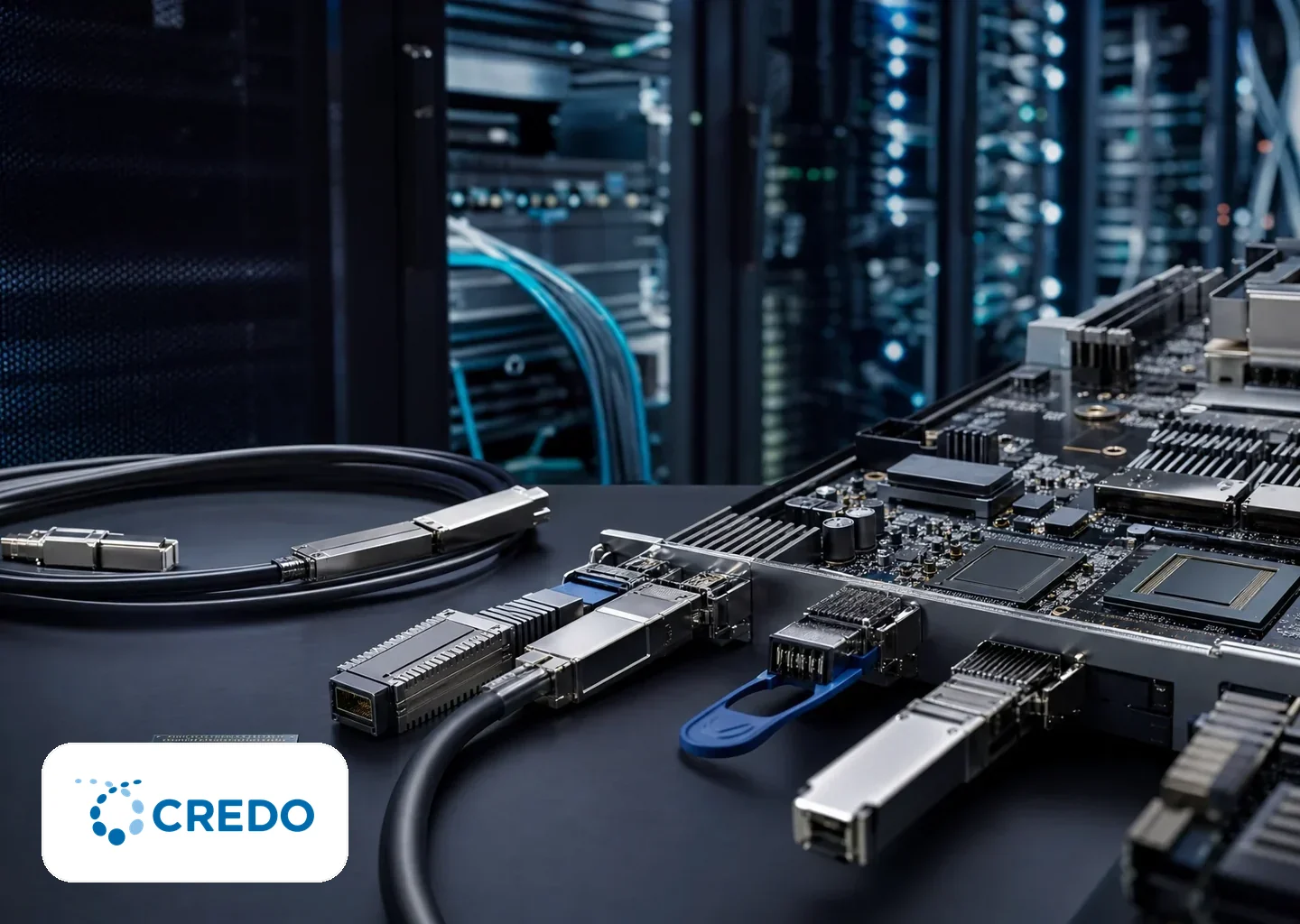
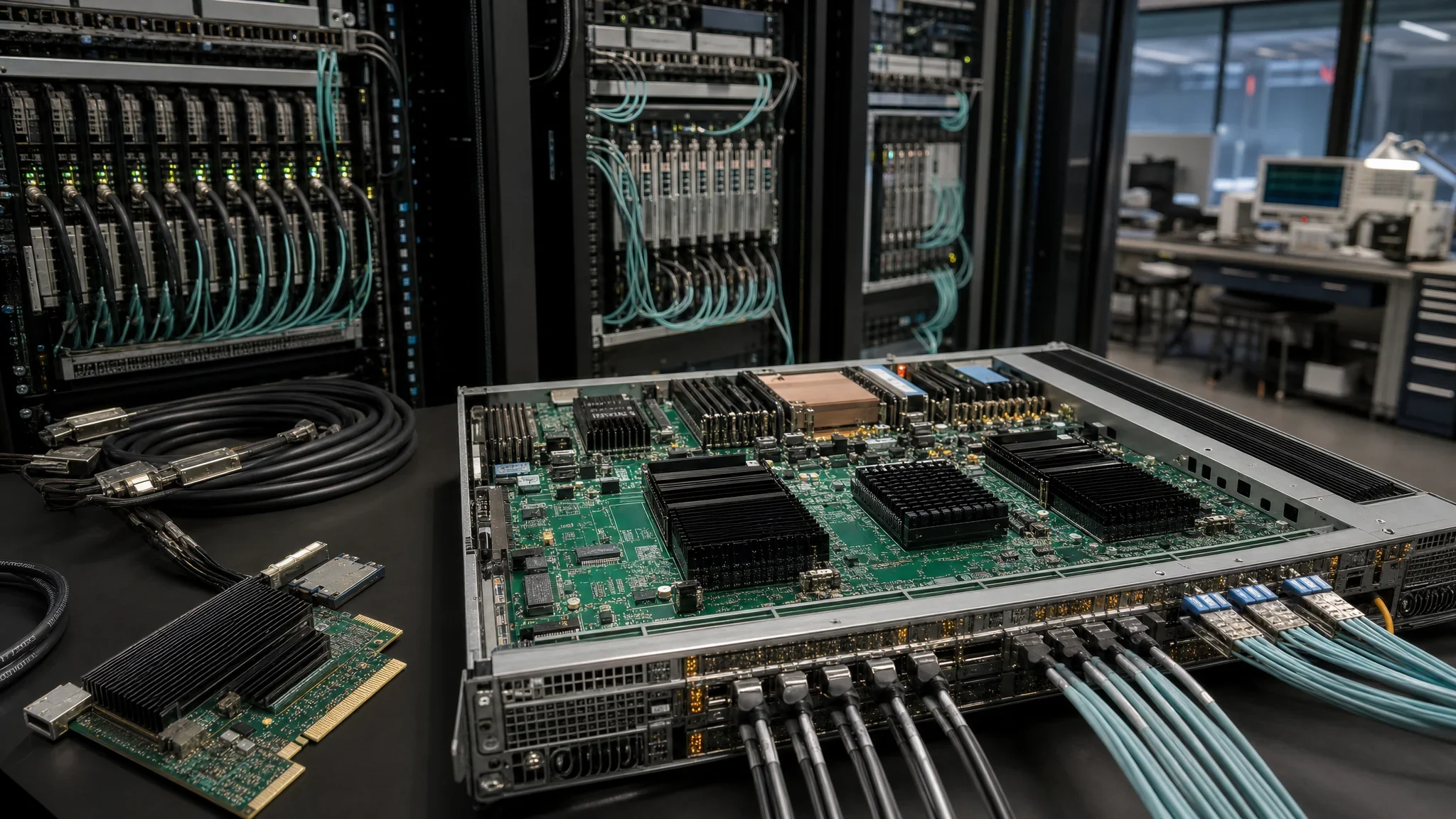
- Active electrical cables: Credo’s ZeroFlap AECs are designed for short-reach AI and data-center links, including GPU-to-switch and rack connectivity. The company positions these products as lower-power and lower-cost alternatives to active optical cables in relevant short-distance use cases.
- Optical connectivity: The portfolio includes optical DSPs, ZeroFlap optical transceivers and newer silicon-photonics technology from the DustPhotonics acquisition. Credo also introduced Bluebird, a 200G/lane optical DSP on a 3nm process node, targeting 1.6 Tb/s transceivers for dense AI data centers.
- Connectivity silicon and IP: Credo sells SerDes chiplets, PCIe retimers and SerDes IP for high-speed data movement across 100G, 200G, 400G, 800G and emerging 1.6T architectures.
- Memory and chip-to-chip connectivity: OmniConnect memory solutions and Hyperlume’s microLED optical interconnect technology extend Credo’s roadmap beyond cables and pluggable optical links into adjacent AI infrastructure interconnect markets.
- Software and diagnostics: PILOT adds diagnostic and analytics capabilities across SerDes, retimers and system-level AECs, with a focus on reducing link flaps, downtime and deployment instability in large-scale clusters.
Credo sells to hyperscalers, neoclouds, OEMs, ODMs, contract manufacturers, optical module manufacturers, enterprise customers and HPC customers. Its direct sales model targets both end users and supply-chain partners, which matters because hyperscale customers influence which connectivity technologies are adopted by OEMs, ODMs, contract manufacturers and module makers.
The company’s main competitive advantage is its specialization in high-speed, energy-efficient connectivity for AI data infrastructure. As AI clusters grow, power efficiency, signal integrity, rack reliability and time-to-stability become more important purchasing factors. Credo’s AEC franchise is a notable differentiator because it addresses short-reach copper connectivity where active optical cables carry higher cost or power consumption. The company also had 86 issued and 39 pending U.S. patents, plus 52 issued and 41 pending mainland China patents as of May 2, 2026, focused largely on Ethernet standards, network cable technology, chip manufacturing/MCM and SerDes cores.
Credo competes with larger semiconductor and connectivity suppliers, including Marvell Technology and Broadcom, especially in optical DSPs, retimers, SerDes and data-center connectivity silicon. Compared with Marvell, Credo is more narrowly focused on high-speed connectivity for AI and data-center networks, while Marvell has a broader semiconductor portfolio across data infrastructure, storage, networking and custom silicon. This narrower focus gives Credo sharper exposure to AI cluster connectivity growth, while also increasing dependence on a smaller set of products and customers.
Credo’s market position is that of a fast-growing specialist in AI data-center connectivity rather than a diversified semiconductor incumbent. Its FY2026 results show that the company has moved from an emerging supplier to a material participant in the AI infrastructure supply chain. Q4 FY2026 GAAP gross margin was 68.2%, and full-year GAAP net income was $472.3 million, showing that growth has been accompanied by strong profitability.
The main weakness in Credo’s market position is concentration. The top 10 customers accounted for about 90% of FY2026 revenue, with Customer A at 49% and Customer B at 32%. The company also generally sells through purchase orders rather than long-term minimum-purchase commitments. That makes customer diversification, product breadth and continued design wins important to sustaining its current growth profile.
Credo’s supply chain is also concentrated. In FY2026 it exclusively used TSMC for semiconductor wafer production, with assembly and test outsourced mainly to Asia-based subcontractors. Mainland China shipment-destination revenue was $80.9 million in FY2026, about 6.1% of total revenue, while Hong Kong shipment-destination revenue was $378.2 million, about 28.3%. These figures reflect shipment destination rather than end-customer headquarters, so they should be read as supply-chain and logistics exposure rather than a clean measure of final demand.