Last Updated -

March 23, 2026

JD.com

Company Profile and Market Insights

Explore the business model, global strategy, and market performance including insights into its position in China.

JD.com
Key facts
Founded 1998 • NASDAQ: JD • Q4 2025 results (Dec 31, 2025 quarter)
RMB352.3b
Revenue (Q4 2025)
RMB(2.7)b
Net loss (Q4 2025)
20.1%
Net service revenue growth (Q4 2025)
3.2%
JD Retail operating margin (Q4 2025)
RMB17.3b
Free cash flow (Q4 2025)
RMB225.4b
Cash, restricted cash + short-term investments (Dec 2025)

About

JD.com traces its roots to 1998 in Beijing and entered e-commerce in January 2004. Today, the company is headquartered in Beijing and has grown from an electronics retailer into a leading supply chain-based technology and service provider. Its development has been shaped by long-term investment in logistics, retail infrastructure, and technology, which turned JD from a single-category seller into one of China’s largest commerce platforms.

JD.com’s business now spans retail, logistics, health, industrial supply chain services, property development, and international operations. The company combines first-party retail, third-party marketplace services, and nationwide fulfillment capabilities, which remain central to its customer experience and operating model. JD states that its mission is to make lives better through technology, with a broader vision of becoming the most trusted company in the world.

Scale remains one of JD.com’s defining strengths. On its current corporate site, JD says it serves over 700 million annual active customers and ranks 44th on the Fortune Global 500, while calling itself China’s largest retailer by revenue. In 2025, JD.com reported full-year net revenues of RMB 1.309 trillion, up 13.0% year over year. In its 2024 annual report, the company also disclosed 570,895 employees, highlighting the breadth of the operating platform behind its commerce and logistics network.

JD.com

Business Model and Market Position

JD.com runs a hybrid commerce model built on direct retail, third-party marketplace services, advertising, and logistics. What sets it apart in China is control over inventory, fulfillment, and service quality across much of the customer journey. The company still carries a large first-party retail business, while service layers are becoming more important to growth and profitability.

  1. Direct retail
    In its online retail business, JD buys products from suppliers and sells them directly to consumers. This model supports pricing control, product authenticity, and faster delivery in categories where trust and fulfillment matter most. As of December 31, 2024, JD sourced products from more than 60,000 suppliers.
  2. Marketplace and advertising
    JD also runs a large third-party marketplace where merchants pay sales commissions and use JD’s transaction, billing, and traffic tools. The platform expands assortment without forcing JD to own all inventory, while advertising and marketing services raise monetization of merchant demand. In 2025, marketplace and marketing revenue rose 18.9% to RMB 107.1 billion.
  3. Logistics and supply chain services
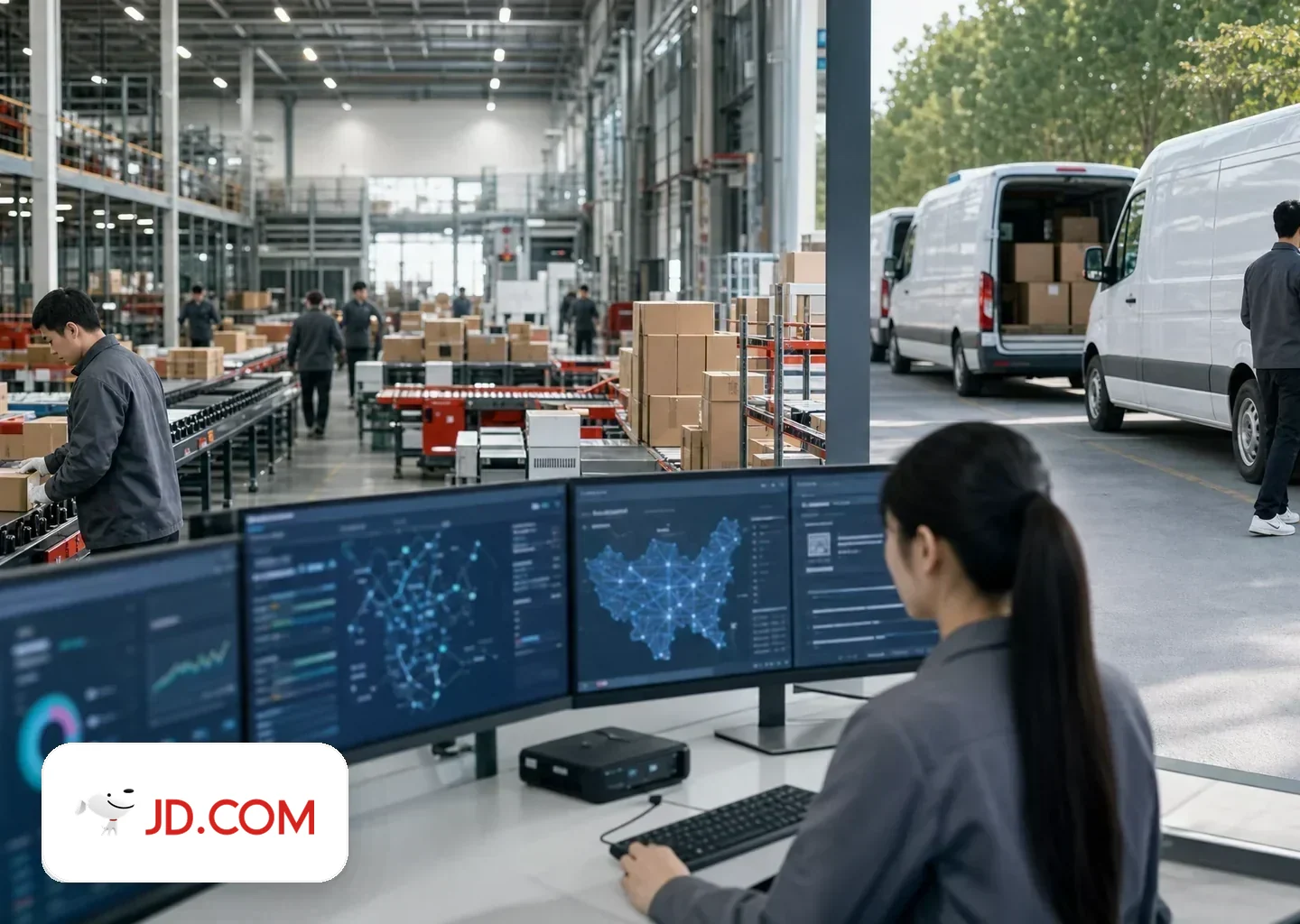
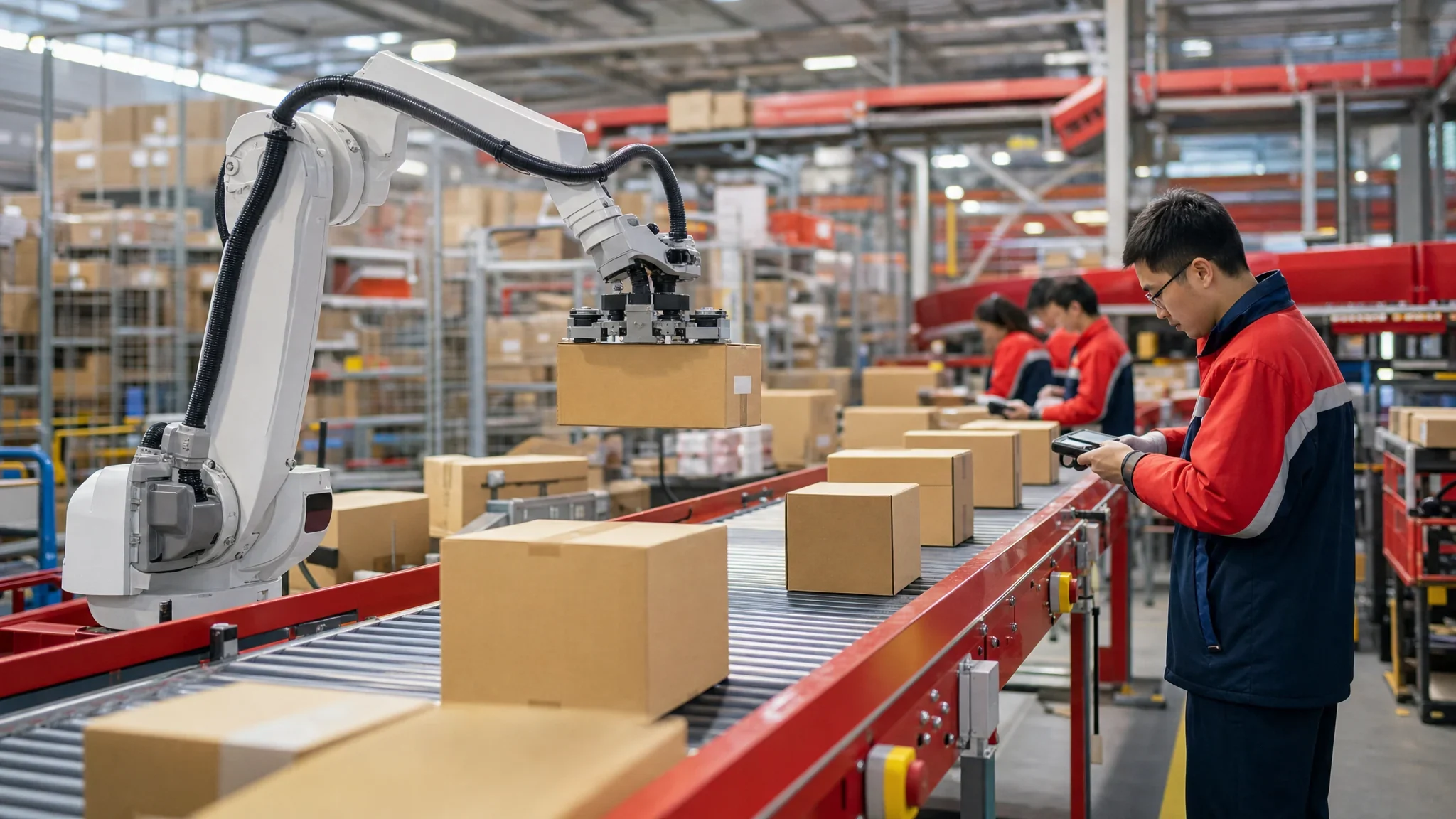
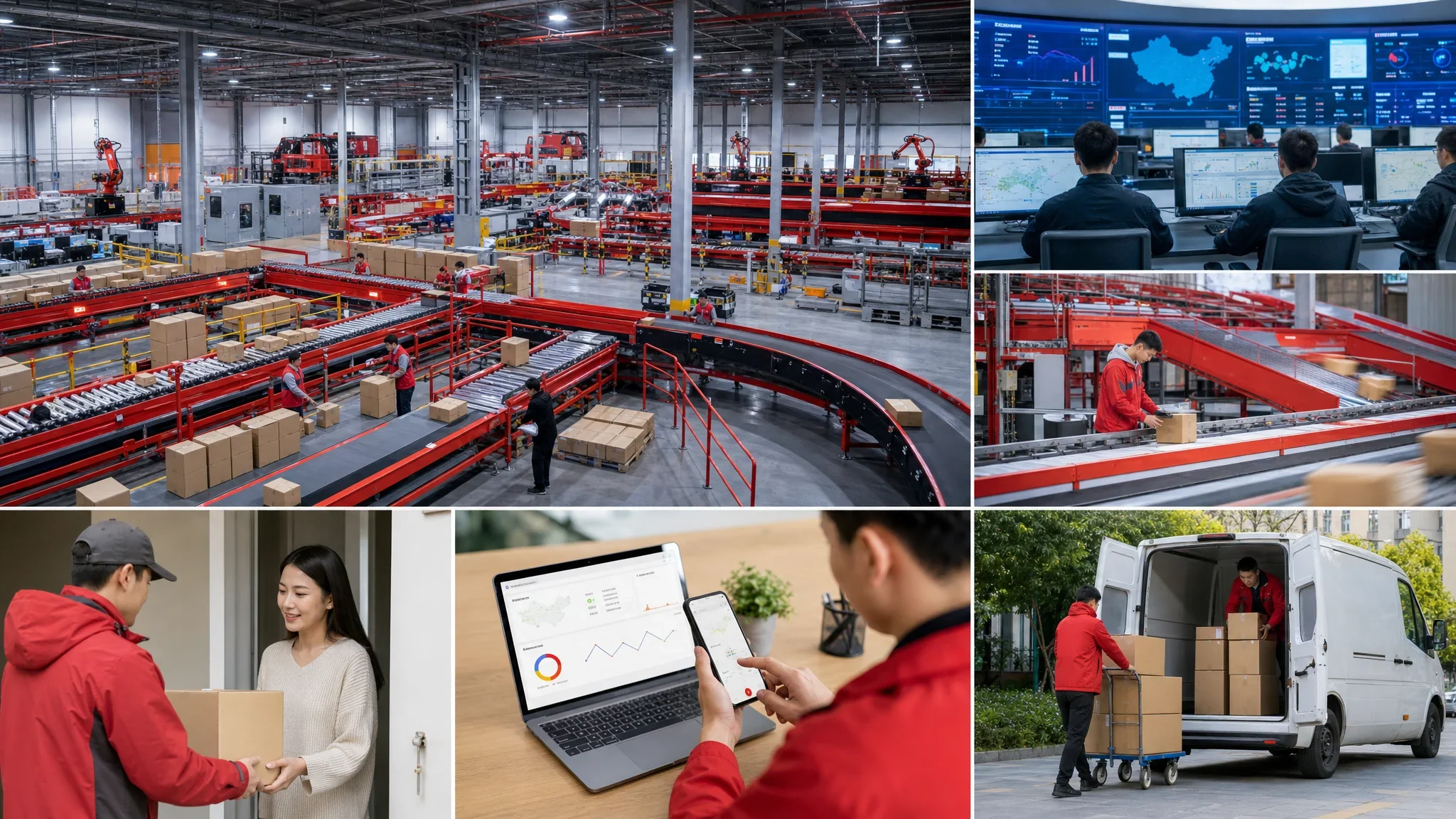
    JD’s largest structural advantage is logistics. The company operates a nationwide warehouse and delivery network, delivers a majority of orders itself, and also sells warehousing, distribution, express, freight, and other supply chain services through JD Logistics. As of December 31, 2024, the network included more than 1,600 self-operated warehouses, more than 2,000 cloud warehouses, and over 32 million square meters of aggregate gross floor area. JD states that this network covered almost all counties and districts in China.
  4. Ecosystem extensions
    JD’s reported segments are JD Retail, JD Logistics, and New Businesses. JD Retail includes operations such as JD Health and JD Industrials, while New Businesses include JD Food Delivery, JD Property, Jingxi, and overseas businesses. This broadens monetization beyond classic online shopping and deepens JD’s role as a supply chain infrastructure provider.

In market position, JD sits between a retailer and a platform. That is the key contrast with marketplace-led peers. Alibaba states that the majority of its China commerce retail revenue comes from customer management services, while JD still combines direct product sales with commissions, ads, and logistics services. For investors, that means tighter control over product quality and delivery, paired with a more operationally intensive model and a large fulfillment cost base.

JD’s scale keeps that model relevant. The company says it serves over 700 million annual active customers and remains China’s largest retailer by revenue. In 2025, JD Retail generated RMB 1.126 trillion in revenue and lifted operating margin to 4.6%, while JD Logistics generated RMB 217.1 billion in revenue. The revenue mix also improved, with net service revenue up 23.6% in 2025 versus 10.3% growth in net product revenue. That shift points to a stronger earnings profile than a pure low-margin retail story.

JD.com

Performance in China

JD.com remains one of China’s strongest retail platforms because its domestic business combines scale, fulfillment control, and trusted service. The company says it serves over 700 million annual active customers and remains China’s largest retailer by revenue. As of December 31, 2024, its warehouse network covered almost all counties and districts across China, with over 1,600 self-operated warehouses, more than 2,000 cloud warehouses, and over 32 million square meters of aggregate gross floor area. Management also said user growth stayed robust in 2025, with shopping frequency rising across the year.

Key strategic drivers in China include:

  1. Fast fulfillment and local reach
    JD delivers a majority of orders itself and continues to lean on same-day and next-day delivery as a core differentiator. It has also expanded instant retail through JD NOW, over 10,000 physical outlets, and millions of local partners, supporting delivery within an hour and in some cases within minutes.
  2. Strength in key categories
    Electronics and home appliances still anchor JD’s market position, while general merchandise and marketplace and marketing revenues recorded double-digit growth in both the fourth quarter and full year 2025. That mix shows JD is still strong in legacy categories while broadening its everyday consumption base.
  3. Competitive position
    JD competes most directly with Alibaba’s Taobao and Tmall on scale and merchant breadth, and with PDD in value-focused online commerce. JD’s edge remains tighter control over fulfillment, product authenticity, and after-sales service. That matters most in branded goods, appliances, and other categories where reliability drives repeat spending. Alibaba is also tightening competition by bringing Taobao, Tmall, Ele.me, and Fliggy into one China e-commerce business group.

Growth and Future Prospects

JD.com entered 2026 with stronger revenue momentum, a better revenue mix, and heavier near-term investment pressure. Full-year 2025 net revenues rose 13.0% to RMB 1.309 trillion. Net service revenues grew 23.6%, ahead of net product revenue growth of 10.3%. JD Retail revenue reached RMB 1.126 trillion and its operating margin improved to 4.6%. At the group level, operating margin fell to 0.2% as JD increased spending on new business initiatives. Management also said user growth stayed robust and shopping frequency increased through 2025.

Key growth drivers include:

  1. A richer service revenue mix
    Marketplace and marketing revenue reached RMB 107.1 billion in 2025, while logistics and other service revenue rose to RMB 178.2 billion. That matters because it shifts JD further away from a pure first-party retail story and gives the company more room to grow through merchant services, ads, and supply chain solutions.
  2. Instant retail and food delivery
    JD Food Delivery showed steady order-volume momentum in the fourth quarter of 2025, a healthier mix between meal and beverage orders, and lower investment than in the prior quarter. JD also said the business was generating synergies with JD Retail through user base expansion, higher shopping frequency, and more cross-category purchases. Reuters reported that management expects food-delivery investment in 2026 to be lower than in 2025, which points to a more disciplined expansion phase after the initial push.
  3. AI and supply chain efficiency
    JD said AI was deeply integrated into its “Super Supply Chain” by the end of 2025. More than 50,000 merchants were using JoyStreamer, JD’s AI customer service handled over 4.2 billion inquiries during the 2025 11.11 promotion, and JD had deployed more than 50,000 internal AI agents. These investments support better merchant tools, tighter operations, and lower service friction across the platform.
  4. Expansion beyond core domestic retail
    JD Industrials listed in Hong Kong on December 11, 2025 and raised approximately RMB 2.6 billion to expand its industrial supply chain capabilities and cross-regional business. JD also accelerated its overseas push. Joybuy launched in the UK, Germany, France, the Netherlands, Belgium, and Luxembourg on March 16, 2026, giving JD a new avenue for growth outside a more competitive and slower domestic market.

Challenges ahead include:

  1. Intense competition across retail and delivery
    JD’s annual report states plainly that the company faces intense competition. In core e-commerce, that pressure comes from Alibaba and PDD. In instant retail and food delivery, JD is competing against Meituan and Alibaba’s Ele.me in a market where regulators have already stepped in to investigate price wars and excessive subsidy competition.
  2. Uneven consumer demand in China
    Reuters reported that weak consumer demand, fading benefits from government subsidies, and pressure on discretionary purchases weighed on JD’s fourth-quarter 2025 comparison. JD’s annual report also says its results are affected by general economic conditions in China and by consumer spending trends. That keeps the near-term outlook tied closely to the pace of China’s household demand recovery.
  3. Margin pressure from new businesses
    JD’s 2025 spending on newer initiatives was significant. Marketing expense rose 75.1% for the year, consolidated operating margin dropped sharply, and the New Businesses segment posted an operating loss of RMB 46.6 billion. This shows that JD is still paying heavily to build newer growth engines, even as the core retail business becomes more efficient.

For investors, the next phase is clear. JD’s core retail engine is in better shape, service revenue is growing faster than product revenue, and newer businesses are starting to show operating signals such as better order mix, user synergies, and lower sequential investment in food delivery. The key question now is whether JD can turn those early signs into repeat demand and healthier unit economics without letting competition erase the gains in margin and mix that the core business delivered in 2025. That reading is based on the 2025 segment results and management’s latest guidance on food-delivery investment.

This Company Profile was written by Dominik Diemer

Dominik Diemer blends an investor mindset with execution discipline.

He is a SAFe Program Consultant (SPC) and Lean Portfolio Management (LPM) practitioner at DMG MORI Digital, working as a SAFe Release Train Engineer and internal consultant in the Lean-Agile Center of Excellence (LACE).

His focus is prioritization, flow, and dependency management that turns strategy into outcomes. With experience across Bertelsmann and the Founders Foundation, he bridges corporate and startup thinking.

He also invests privately in private equity deals, sharpening his view on business models, value drivers, and go-to-market.

StockCounterParts reflects that lens.