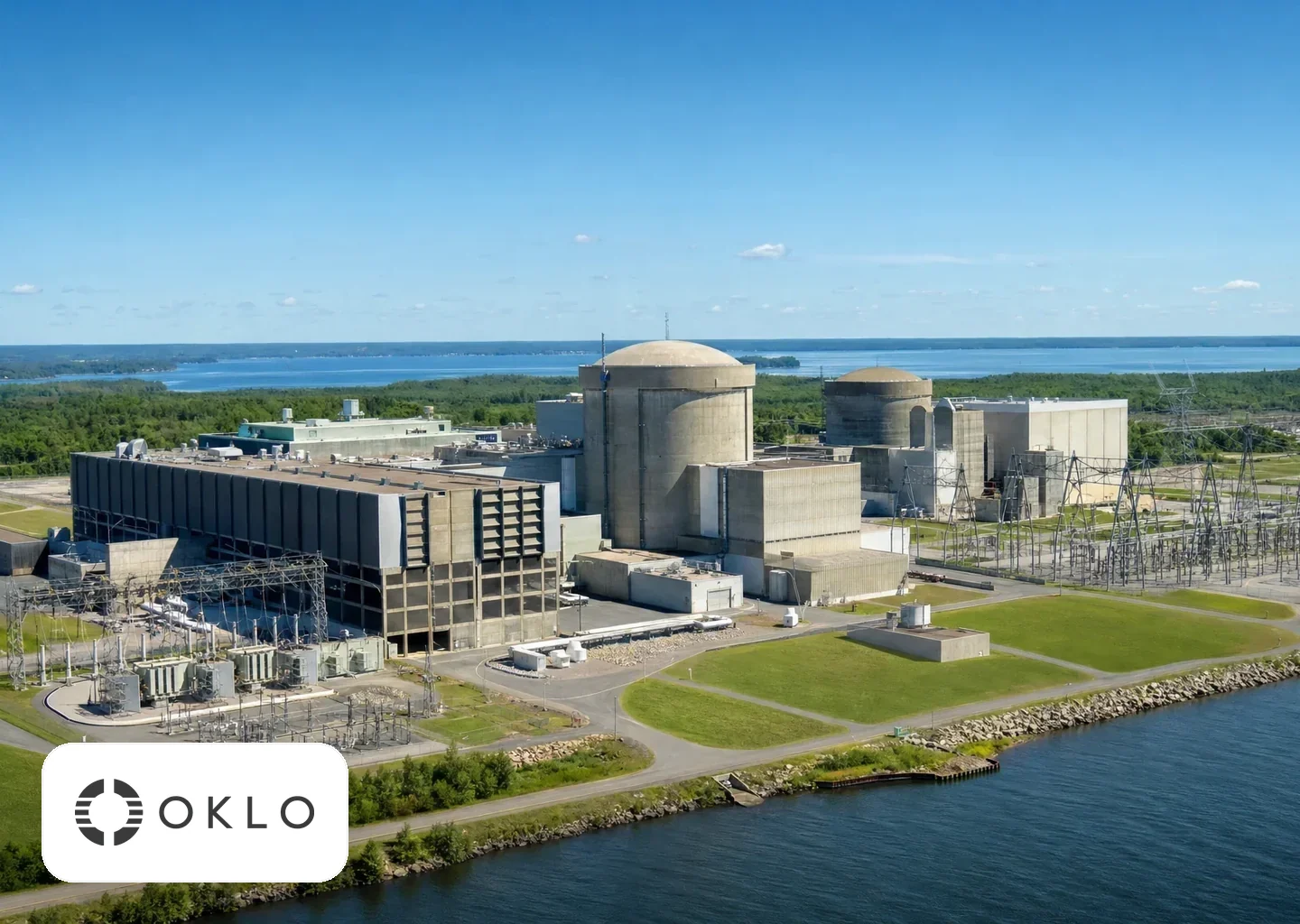
Oklo is a development-stage advanced nuclear company. Its business model is built around owning and operating small fast fission power plants, then selling electricity and heat to customers rather than primarily selling reactor equipment. The company also aims to build linked businesses in nuclear fuel recycling and critical radioisotope production.
Oklo had not reached commercial power generation as of Q1 2026. It reported a Q1 2026 net loss of $33.1 million, a loss from operations of $51.2 million, and operating cash use of $17.9 million. Its cash, cash equivalents, and marketable debt securities were $2.5369 billion at March 31, 2026, giving it a large funding base for engineering, licensing, fuel work, manufacturing, and early deployment.
- Power generation: The Aurora powerhouse is Oklo’s core product platform. It is intended to supply clean electricity and heat to data centers, industrial users, defense and government sites, and utilities.
- Fuel recycling: Oklo plans to convert used nuclear fuel into usable fuel for its own powerhouses and potentially for other customers. This is central to its vertical integration strategy, since fuel access and qualification remain major constraints for advanced nuclear deployment.
- Radioisotopes: Through Atomic Alchemy and related activities, Oklo targets medical, industrial, space, defense, and research isotope markets. The Groves Isotopes Test Reactor is a near-term milestone, with the company targeting criticality by July 4, 2026.
- Manufacturing and supply chain: The June 2026 acquisition of ARMEC expands Oklo’s vertically integrated manufacturing capabilities for advanced reactor and fuel-manufacturing programs. Fuel partnerships, including the June 2026 letter of intent with Centrus and alliance with Standard Nuclear, support the same strategy.
Oklo’s competitive position rests on four main points: fast fission technology, a compact powerhouse design, a build-own-operate model, and a strategy that links power generation with fuel recycling and isotope production. Company materials state that Oklo was the first to receive a U.S. Department of Energy site-use permit for a commercial advanced fission plant, was awarded fuel from Idaho National Laboratory, and submitted the first custom combined license application for an advanced reactor to the U.S. Nuclear Regulatory Commission.
The company is positioned as one of the more visible publicly traded advanced nuclear developers in the United States. Its market narrative has strengthened with rising demand for firm power from AI data centers, industrial electrification, energy security needs, and policy support for domestic nuclear supply chains. The January 2026 agreement with Meta supporting development of a 1.2 GW advanced nuclear power campus in Pike County, Ohio is an important customer-validation marker, though it does not mean commercial revenue has begun.
Oklo competes with public SMR company NuScale Power and private advanced nuclear developers such as TerraPower and X-energy. Compared with NuScale, which is associated with light-water SMR technology, Oklo is differentiated by its fast-reactor design, fuel-recycling ambitions, and plan to own generating assets. Compared with TerraPower and X-energy, Oklo’s public listing gives investors direct market exposure, but it also creates closer scrutiny of cash burn, dilution, licensing progress, and deployment timelines.
China is not a meaningful reported market for Oklo. Its current development, regulatory, and strategic activity is concentrated in the United States, including Idaho, Ohio, Texas, Tennessee, DOE and national laboratory programs, and U.S. fuel-supply partnerships. China is more relevant as an indirect industry comparison, since it is building advanced nuclear capacity domestically.
Oklo’s market position is high-potential and high-risk. The company has meaningful cash resources, visible strategic relationships, and recent DOE and NRC milestones, including 2026 safety-design and principal design criteria approvals. Its economics remain unproven because no Oklo commercial powerhouse is operating. The investment case depends on licensing success, construction execution, fuel availability, long-term customer contracts, and disciplined capital deployment.